
Hellenic Navy | Tweet
Published in Greece  - Social interactions and entertainment - 2 - 07 Oct 19 01:43
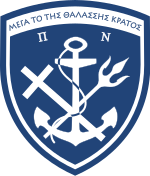
The Hellenic Navy (HN; Greek: Πολεμικό Îαυτικό, Polemikó Naftikó, abbreviated ΠÎ) is the naval force of Greece, part of the Hellenic Armed Forces. The modern Greek navy has its roots in the naval forces of various Aegean Islands, which fought in the Greek War of Independence. During the periods of monarchy (1833–1924 and 1936–1973) it was known as the Royal Hellenic Navy (Βασιλικόν Îαυτικόν, Vasilikón Naftikón, abbreviated ΒÎ).The total displacement of the fleet is approximately 150,000 tons and it is the 22nd largest Navy in the world by total number of vessels. The HN also operates a number of naval aviation units.The motto of the Hellenic Navy is ÎœÎγα τὸ τῆς θαλάσσης κÏάτος from Thucydides account of Pericles oration on the eve of the Peloponnesian War. This has been translated as The rule of the sea is a great matter. The Hellenic Navys emblem consists of an anchor in front of a crossed Christian cross and trident, with the cross symbolizing Greek Orthodoxy, and the trident symbolizing Poseidon, the god of the sea in Greek mythology. Pericles words are written across the top of the emblem.
The history of the Hellenic Navy begins with the birth of modern Greece, and due to the maritime nature of the country, it has always featured prominently in modern Greeces military history.
The Navy during the Revolution (1821–1830)
At the beginning of the Greek War of Independence, the naval forces of the Greeks consisted primarily of the merchant fleet of the Saronic islanders from Hydra, Spetsai and Poros and also the islanders of Psara and Samos. The fleet was of crucial importance to the success of the revolt. Its goal was to prevent as much as possible the Ottoman Navy from resupplying the isolated Ottoman garrisons and land reinforcements from the Ottoman Empires Asian provinces.
Although Greek crews were experienced seamen, the light Greek ships, mostly armed merchantmen, were unable to stand up to the large Turkish ships of the line in direct combat. So the Greeks conducted the equivalent of modern-day naval special operations, resorting to the use of fireships (Greek: πυÏπολικά or μπουÏλότα), with great success. It was in the use of such ships that courageous seamen like Constantine Kanaris won international renown. Under the leadership of capable admirals, most prominently Andreas Miaoulis of Hydra, the Greek fleet achieved early victories, guaranteeing the survival of the revolt in the mainland.
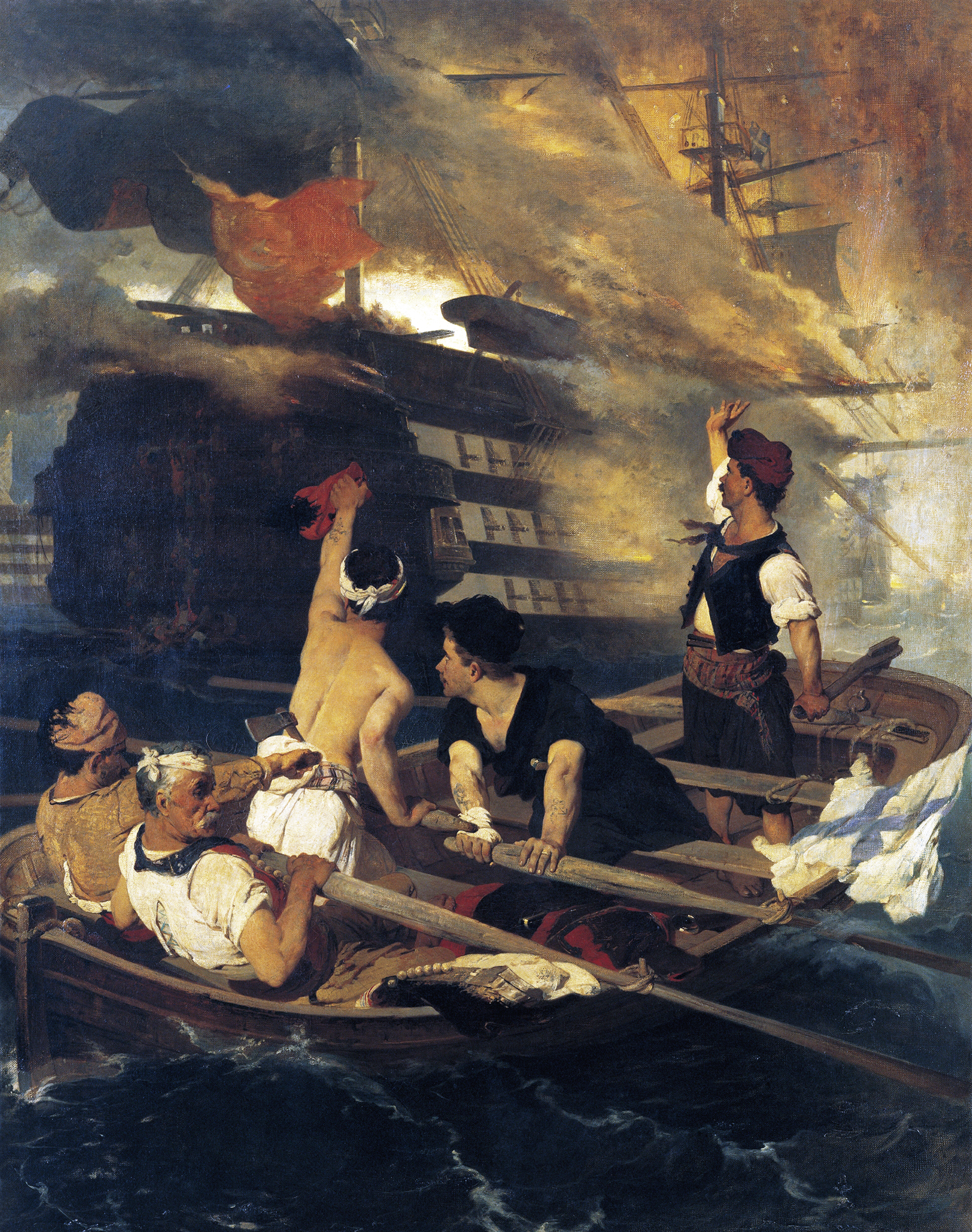 
The destruction of the Ottoman flagship at Chios by Constantine Kanaris. Painting by Nikiphoros Lytras.
However, as Greece became embroiled in a civil war, the Sultan called upon his strongest subject, Muhammad Ali of Egypt, for aid. Plagued by internal strife and financial difficulties in keeping the fleet in constant readiness, the Greeks failed to prevent the capture and destruction of Kasos and Psara in 1824, or the landing of the Egyptian army at Modon. Despite victories at Samos and Gerontas, the Revolution was threatened with collapse until the intervention of the Great Powers in the Battle of Navarino in 1827. There the Egypto-Ottoman fleet was decisively defeated by the combined fleets of the Britain, France and the Russian Empire, effectively securing the independence of Greece.When Ioannis Capodistrias became governor of newly liberated Greece in 1828, the Greek fleet consisted of few remaining ships, which had participated in the war for independence. The first minister of Naval affairs was Constantine Kanaris, and the most powerful ship of the fleet at that time, the frigate Hellas, had been constructed in the United States in 1825. The Hellenic Navy established its headquarters at the island of Poros and the building of a new series of ships began at the naval base while old ships were gradually being retired. Furthermore, continuous efforts towards the education of officers were initiated. Young people were initially trained at the military school of Scholi Evelpidon and afterwards they were transferred to the navy, as there was no such thing as a Naval Academy.In 1831, Greece descended into anarchy with numerous areas, including Mani and Hydra, in revolt. It was during this revolt that the flagship Hellas, docked at Poros, was set on fire by Admiral Andreas Miaoulis.Capodistrias was assassinated a few months after.
The Royal Hellenic Navy of King Otto (1830–1860)

The sortie of the Greek brig Aris during the Greek War of Independence, by Konstantinos Volanakis.
When the new King Otto arrived in the Greek capital, Nafplion, in 1832 aboard the British warship HMS Madagascar, the Greek fleet consisted of 1 corvette, 3 brigs, 6 gollettes, 2 gunboats, 2 steamboats and a few more small vessels. The first Naval School was founded in 1846 on the Corvette Loudovikos and Leonidas Palaskas was assigned as its director. However the inefficient training of the officers, coupled with conflict between those who pursued modernization and those who were stalwarts of the traditions of the veterans of the struggle for independence, resulted in a restricted and inefficient navy, which was limited to policing the sea and the pursuit of pirates.During the 1850s, the more progressive elements of the navy won out and the fleet was augmented with more ships. In 1855, the first iron propeller-driven ships were ordered from England. These were the steamships Panopi, Pliksavra, Afroessa, and Sfendoni.
Growth of the Navy under King George (1860–1910)
 Navy uniforms in the 1890s
 Battleship PsaraOn October 29, 1863, following an enthronement ceremony in his native Copenhagen and a tour of several of the European capitals, Prince Wilhelm of Denmark arrived aboard the Greek flagship Hellas, to take up the throne as King George I of Greece. During the 1866 Cretan revolt, the ships of the Royal Hellenic Navy were in no condition to support it. Such failure led to the government awakening to the problem of naval insufficiency and the adoption of a policy stating that: The navy, as it represents a necessary weapon for Greece, should only be created for war and aim to victory. Because of this, the fleet was supplied with new and bigger ships, reflecting a number of innovations including the use of iron in shipbuilding industry and the invention of the torpedo; with these advances, the effectiveness and the appearance of the Hellenic Navy changed.Meanwhile, after 1878, because of the Russo-Turkish War and the need to expand the Greek navy, a new and larger naval base was established in the area of Faneromeni of Salamis and a few years later it was transferred to the area of Arapis where it remains today. At the same time the Naval Academy was founded and Ilias Kanellopoulos was made Director. A committee from France headed by Admiral Lejeune introduced a new, advanced naval organization and the methodological training of enlisted personnel through the establishment of a training school in the old building of the naval base in Poros. During the government of Charilaos Trikoupis in 1889, the fleet was further increased with the acquisition of new battleships:Hydra, Spetsai, and Psara from France. Thus, when Greece went to war in the Greco-Turkish War in 1897, the Hellenic Navy established its dominance in the Aegean Sea. However, it was unable to change the outcome of the war on land, which was a national humiliation.In 1907, the Hellenic Navy General Staff (Γενικό Επιτελείο ÎαυτικοÏ) was founded, with then-Captain Pavlos Kountouriotis as its first head. After the war, in 1897, the Ottoman Empire embarked on a program of naval expansion for its fleet and as a response to that, in 1909, the cruiser Georgios Averof was bought from Italy. In 1910, an English naval mission arrived, headed by Admiral Tuffnel, in order to recommend improvements in the organization and training of the navy. The mission led to the adoption of the English style of management, organization and training, especially in the area of strategy.
Balkan Wars (1912–1913)
 Admiral Pavlos Kountouriotis and the crew of Averof,
1912
The Navy, shortly before the Balkan Wars, was composed of a destroyer and battleship fleet. Its mission was primarily offensive, aiming at capturing the Ottoman-held islands of the Eastern Aegean, and establish naval supremacy in the area. To that end, its commander-in-chief, Rear Admiral Pavlos Kountouriotis, established a forward base at the Moudros bay at Lemnos, directly opposite the Dardanelles straits. After defeating the two Turkish sallies from the Straits at Elli (December 1912) and Lemnos (January 1913), the Aegean Sea was secured for Greece.The Balkan Wars were followed by a rapid escalation between Greece and the Ottoman Empire over the as yet unclear status of the islands of the Eastern Aegean. Both governments embarked on a naval armaments race, with Greece purchasing the obsolete battleships Lemnos and Kilkis and the light cruiser Elli as well as ordering two dreadnoughts, the Vasilefs Konstantinos and the Salamis and a number of destroyers. However, with the outbreak of the First World War, construction of the dreadnoughts stopped.
 
Cruiser Georgios Averof
END OF PART 1
The navy, as it represents a necessary weapon for Greece, should only be created for war and aim to victory.— Greek Government (1866)
History
The history of the Hellenic Navy begins with the birth of modern Greece, and due to the maritime nature of the country, it has always featured prominently in modern Greeces military history.
The Navy during the Revolution (1821–1830)
At the beginning of the Greek War of Independence, the naval forces of the Greeks consisted primarily of the merchant fleet of the Saronic islanders from Hydra, Spetsai and Poros and also the islanders of Psara and Samos. The fleet was of crucial importance to the success of the revolt. Its goal was to prevent as much as possible the Ottoman Navy from resupplying the isolated Ottoman garrisons and land reinforcements from the Ottoman Empires Asian provinces.
Although Greek crews were experienced seamen, the light Greek ships, mostly armed merchantmen, were unable to stand up to the large Turkish ships of the line in direct combat. So the Greeks conducted the equivalent of modern-day naval special operations, resorting to the use of fireships (Greek: πυÏπολικά or μπουÏλότα), with great success. It was in the use of such ships that courageous seamen like Constantine Kanaris won international renown. Under the leadership of capable admirals, most prominently Andreas Miaoulis of Hydra, the Greek fleet achieved early victories, guaranteeing the survival of the revolt in the mainland.
The destruction of the Ottoman flagship at Chios by Constantine Kanaris. Painting by Nikiphoros Lytras.
However, as Greece became embroiled in a civil war, the Sultan called upon his strongest subject, Muhammad Ali of Egypt, for aid. Plagued by internal strife and financial difficulties in keeping the fleet in constant readiness, the Greeks failed to prevent the capture and destruction of Kasos and Psara in 1824, or the landing of the Egyptian army at Modon. Despite victories at Samos and Gerontas, the Revolution was threatened with collapse until the intervention of the Great Powers in the Battle of Navarino in 1827. There the Egypto-Ottoman fleet was decisively defeated by the combined fleets of the Britain, France and the Russian Empire, effectively securing the independence of Greece.When Ioannis Capodistrias became governor of newly liberated Greece in 1828, the Greek fleet consisted of few remaining ships, which had participated in the war for independence. The first minister of Naval affairs was Constantine Kanaris, and the most powerful ship of the fleet at that time, the frigate Hellas, had been constructed in the United States in 1825. The Hellenic Navy established its headquarters at the island of Poros and the building of a new series of ships began at the naval base while old ships were gradually being retired. Furthermore, continuous efforts towards the education of officers were initiated. Young people were initially trained at the military school of Scholi Evelpidon and afterwards they were transferred to the navy, as there was no such thing as a Naval Academy.In 1831, Greece descended into anarchy with numerous areas, including Mani and Hydra, in revolt. It was during this revolt that the flagship Hellas, docked at Poros, was set on fire by Admiral Andreas Miaoulis.Capodistrias was assassinated a few months after.
The Royal Hellenic Navy of King Otto (1830–1860)

The sortie of the Greek brig Aris during the Greek War of Independence, by Konstantinos Volanakis.
When the new King Otto arrived in the Greek capital, Nafplion, in 1832 aboard the British warship HMS Madagascar, the Greek fleet consisted of 1 corvette, 3 brigs, 6 gollettes, 2 gunboats, 2 steamboats and a few more small vessels. The first Naval School was founded in 1846 on the Corvette Loudovikos and Leonidas Palaskas was assigned as its director. However the inefficient training of the officers, coupled with conflict between those who pursued modernization and those who were stalwarts of the traditions of the veterans of the struggle for independence, resulted in a restricted and inefficient navy, which was limited to policing the sea and the pursuit of pirates.During the 1850s, the more progressive elements of the navy won out and the fleet was augmented with more ships. In 1855, the first iron propeller-driven ships were ordered from England. These were the steamships Panopi, Pliksavra, Afroessa, and Sfendoni.
Growth of the Navy under King George (1860–1910)
 Navy uniforms in the 1890s
 Battleship PsaraOn October 29, 1863, following an enthronement ceremony in his native Copenhagen and a tour of several of the European capitals, Prince Wilhelm of Denmark arrived aboard the Greek flagship Hellas, to take up the throne as King George I of Greece. During the 1866 Cretan revolt, the ships of the Royal Hellenic Navy were in no condition to support it. Such failure led to the government awakening to the problem of naval insufficiency and the adoption of a policy stating that: The navy, as it represents a necessary weapon for Greece, should only be created for war and aim to victory. Because of this, the fleet was supplied with new and bigger ships, reflecting a number of innovations including the use of iron in shipbuilding industry and the invention of the torpedo; with these advances, the effectiveness and the appearance of the Hellenic Navy changed.Meanwhile, after 1878, because of the Russo-Turkish War and the need to expand the Greek navy, a new and larger naval base was established in the area of Faneromeni of Salamis and a few years later it was transferred to the area of Arapis where it remains today. At the same time the Naval Academy was founded and Ilias Kanellopoulos was made Director. A committee from France headed by Admiral Lejeune introduced a new, advanced naval organization and the methodological training of enlisted personnel through the establishment of a training school in the old building of the naval base in Poros. During the government of Charilaos Trikoupis in 1889, the fleet was further increased with the acquisition of new battleships:Hydra, Spetsai, and Psara from France. Thus, when Greece went to war in the Greco-Turkish War in 1897, the Hellenic Navy established its dominance in the Aegean Sea. However, it was unable to change the outcome of the war on land, which was a national humiliation.In 1907, the Hellenic Navy General Staff (Γενικό Επιτελείο ÎαυτικοÏ) was founded, with then-Captain Pavlos Kountouriotis as its first head. After the war, in 1897, the Ottoman Empire embarked on a program of naval expansion for its fleet and as a response to that, in 1909, the cruiser Georgios Averof was bought from Italy. In 1910, an English naval mission arrived, headed by Admiral Tuffnel, in order to recommend improvements in the organization and training of the navy. The mission led to the adoption of the English style of management, organization and training, especially in the area of strategy.
Balkan Wars (1912–1913)
 Admiral Pavlos Kountouriotis and the crew of Averof,
1912
The Navy, shortly before the Balkan Wars, was composed of a destroyer and battleship fleet. Its mission was primarily offensive, aiming at capturing the Ottoman-held islands of the Eastern Aegean, and establish naval supremacy in the area. To that end, its commander-in-chief, Rear Admiral Pavlos Kountouriotis, established a forward base at the Moudros bay at Lemnos, directly opposite the Dardanelles straits. After defeating the two Turkish sallies from the Straits at Elli (December 1912) and Lemnos (January 1913), the Aegean Sea was secured for Greece.The Balkan Wars were followed by a rapid escalation between Greece and the Ottoman Empire over the as yet unclear status of the islands of the Eastern Aegean. Both governments embarked on a naval armaments race, with Greece purchasing the obsolete battleships Lemnos and Kilkis and the light cruiser Elli as well as ordering two dreadnoughts, the Vasilefs Konstantinos and the Salamis and a number of destroyers. However, with the outbreak of the First World War, construction of the dreadnoughts stopped.
Cruiser Georgios Averof
END OF PART 1
Support
SaferEl GrecotsiggerDCLXVlchris dudeComments (2)


08 Oct 19 12:26
chris dudean incredible analysis about our glorious greek navy. (a navy with a long standing skill+tradition, starting from early antiquity, and reaching until the modern years) ζητω η ελλαδα και το ηÏωικο ελληνικο ναυτικο μας!
 Facebook
 Instagram
 Discord
 Reddit