Panathinaikos Football Club (
Greek: ΠΑΕ Παναθηναϊκός Α.Ο.Â
 , known asÂ
Panathinaikos, or by its full name, and the name of its parent sports club,Â
Panathinaikos A.O. orÂ
PAO (Παναθηναϊκός Αθλητικός Όμιλος;Â
Panathinaïkós Athlitikós Ómilos, All-Athenian Athletic Club), is aÂ
Greek professionalÂ
football club based in the capital-city ofÂ
Athens.The name Panathinaikos was inspired by the ancient work ofÂ
Isocrates,Â
Panathenaicus, where the orator praises theÂ
Athenians for their democratic education and their military superiority, used for the benefit of allÂ
Greeks.Today a part ofÂ
Panathinaikos A.O., they are the oldest active football club in Greece, initially founded only to practice this sport Created in 1908 as Podosfairikos Omilos Athinon (
Football Club of Athens) byÂ
Georgios Kalafatis, they play in theÂ
Super League Greece, being one of the mostÂ
successful clubs inÂ
Greek football and one of three clubs which haveÂ
never been relegated from the top division. Amongst their major titles are 20Â
Greek Championships, 18Â
Greek Cups, achieving eight times theÂ
Double, and 3Â
Greek Super Cups. They are also one of the two clubs that won a championshipÂ
undefeated, going without a loss in a top-flight campaign in theÂ
1963–64 season.Panathinaikos is also the most successful Greek club in terms of achievements in the European competitions. It is the only Greek team that has reached the European Cup (later renamedÂ
UEFA Champions League) final inÂ
1971Â (which they lost toÂ
Ajax Amsterdam 2–0),


and also the semi-finals twice, in 1985 and 1996. It is also the only Greek team that has played for theÂ
Intercontinental Cup (1971). Furthermore, they have reached the quarter-finals of the Champions League on another two occasions (in 1992 and 2002), as well as the quarter-finals of theÂ
UEFA Cup twice (1988 and 2003). They have also won theÂ
Balkans Cup in 1977. Panathinaikos is a member of theÂ
European Club Association.Since the 1950s, the club maintains some of the oldest and most successfulÂ
academies in Greece, producing talent for the first team and feeding theÂ
Greek national football team. They have played their home games in theÂ
Apostolos Nikolaidis Stadium, considered their traditional home ground, and theÂ
Athens Olympic Stadium.According to the most recent researches and polls, Panathinaikos is the second-most popular football team in Greece, with the percentage difference betweenÂ
Olympiacos and themselves varying between 2% to 9%. The club has million of fans inside Greece and millions of others in theÂ
Greek communities all over the world.They hold a long-term rivalry with Olympiacos, the clash between the two teams being referred to as the
Derby of the eternal enemies. It is traditionally included among the worlds greatest football derbies.


According to the official history of the club, Panathinaikos was founded byÂ
Giorgos Kalafatis on 3 February 1908, when he and 40 other athletes decided to break away fromÂ
Panellinios Gymnastikos Syllogos following the clubs decision to discontinue its football team. The name of the new club was Podosferikos Omilos Athinon (
Football Club of Athens). It was founded with the aim of spreading and making more known this new sport (
football) to the Athenian and Greek public in general. Also, the intention of the founders was to create a team for all of Athens and to be connected with the rest of the European football movement, which was already active. The first president elected was Alexandros Kalafatis, brother of Giorgos. The ground of the team was inÂ
Patission Street.Â
Oxford University athleteÂ
John Cyril Campbell was brought in as coach, the first time that a foreigner was appointed as the coach of a Greek team.Â
Konstantinos Tsiklitiras, the great Greek athlete of the early 20th century, played as goalkeeper for the new team.
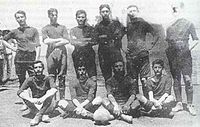

The first team of 1908
In 1910, after a dispute among a number of board members, Kalafatis with most of the players—also followed by Campbell—decided to pull out of POA and secured a new ground inÂ
Amerikis Square. Subsequently, the name of the club changed to Panellinios Podosferikos Omilos (Panhellenic Football Club) and its colours to green and white. By 1914, Campbell had returned to England but the club was already at the top of Greek football with players such asÂ
Michalis Papazoglou, Michalis Rokkos andÂ
Loukas Panourgias.In 1918, the team adopted theÂ
trifolium (
shamrock) as its emblem, as proposed byÂ
Michalis Papazoglou. In 1921 and 1922, theÂ
Athens-Piraeus FCAÂ organized the first two post-
WWIÂ championships, in both of which PPO was declared champion. By that stage, the club had outgrown both the grounds in Patission Street and Amerikis Square, due mainly to its expansion in other sports, and began to look at vacant land in the area of Perivola onÂ
Alexandras Avenue as its potential new ground. After long discussions with theÂ
Municipality of Athens, an agreement was finally reached and in 1922Â
Leoforos (Avenue in Greek) was granted to the club.The move to a permanent home ground also heralded another—final—name change toÂ
Panathinaikos Athlitikos Omilos (PAO),
All-Athenian Athletic Club, on 15 March 1924, from now on aÂ
multi-sport club. However, the decision was already taken by 1922.

The champion team of 1930
In 1926, theÂ
Hellenic Football Federation (HFF) was founded and the firstÂ
Greek Championship under its authority took place in 1927.
anathinaikos won undefeated the Championship ofÂ
1929–30 under the guidance ofÂ
József Künsztler andÂ
Angelos Messaris as the teams star player. Other notable players of thisÂ
Belle Époque period of the team wereÂ
Antonis Migiakis,Â
Diomidis Symeonidis,Â
Mimis Pierrakos andÂ
Stefanos Pierrakos, among others. They thrashed rivalsÂ
Olympiacos 8–2, a result that still remains the biggest win either team has achieved against its rival, with Messaris scoring three goals. The team also defeatedÂ
Aris 1–4 away inÂ
Thessaloniki. Messaris, who scored again three goals, became a hero and chant for the fans.“We scored eight against Olympiacos, and four more against Aris, hooray Angelos Messarisâ€


Angelos Messaris, the legendary player of the 30s

 - Social interactions and entertainment - 3 - 18 Dec 19 09:53



 Facebook
 Instagram
 Discord
 Reddit