
World War I (part 2) | Tweet
Published in Greece  - Social interactions and entertainment - 0 - 23 Dec 19 08:35
The term First World War was first used in September 1914 by German biologist and philosopher Ernst Haeckel, who claimed that there is no doubt that the course and character of the feared European War ... will become the first world war in the full sense of the word, citing a wire service report in The Indianapolis Star on 20 September 1914.Prior to World War II, the events of 1914–1918 were generally known as the Great War or simply the World War. In October 1914, the Canadian magazine Macleans wrote, Some wars name themselves. This is the Great War. Contemporary Europeans also referred to it as the war to end war or the war to end all wars due to their perception of its then-unparalleled scale and devastation. After World War II began in 1939, the terms became more standard, with British Empire historians, including Canadians, favouring The First World War and Americans World War I
 
Background
Political and military alliances
For much of the 19th century, the major European powers had tried to maintain a tenuous balance of power among themselves, resulting in a complex network of political and military alliances. The biggest challenges to this were Britains withdrawal into so-called splendid isolation, the decline of the Ottoman Empire and the post-1848 rise of Prussia under Otto von Bismarck. Victory in the 1866 Austro-Prussian War established Prussian hegemony in Germany, while victory over France in the 1870–1871 Franco-Prussian War unified the German states into a German Reich under Prussian leadership.In 1873, to isolate France and avoid a war on two fronts, Bismarck negotiated the League of the Three Emperors (German: Dreikaiserbund) between Austria-Hungary, Russia and Germany. Concerned by Russias victory in the 1877–1878 Russo-Turkish War and their influence in the Balkans, the League was dissolved in 1878, with Germany and Austria-Hungary subsequently forming the 1879 Dual Alliance; this became the Triple Alliance when Italy joined in 1882.The practical details of these alliances were limited, since their primary purpose was to ensure cooperation between the three Imperial Powers and isolate France. Attempts by Britain in 1880 to resolve colonial tensions with Russia and diplomatic moves by France led to Bismarck reforming the League in 1881. When the League finally lapsed in 1887, it was replaced by the Reinsurance Treaty, a secret agreement between Germany and Russia to remain neutral if either were attacked by France or Austria-Hungary.In 1890, the new German Emperor, Kaiser Wilhelm II, forced Bismarck to retire and was persuaded not to renew the Reinsurance Treaty by the new Chancellor, Leo von Caprivi. This allowed France to counteract the Triple Alliance with the Franco-Russian Alliance of 1894 and the 1904 Entente Cordiale with Britain, while in 1907 Britain and Russia signed the Anglo-Russian Convention. The agreements did not constitute formal alliances, but by settling long-standing colonial disputes, they made British entry into any future conflict involving France or Russia a possibility; these interlocking bilateral agreements became known as the Triple Entente
Arms race
The creation of the German Reich following victory in the 1871 Franco-Prussian War led to a massive increase in Germanys economic and industrial strength. Admiral Alfred von Tirpitz and Wilhelm II, who became Emperor in 1890, sought to use that to create a Kaiserliche Marine or Imperial German Navy to compete with Britains Royal Navy for world naval supremacy. In doing so, they were influenced by US naval strategist Alfred Mahan, who argued possession of a blue-water navy was vital for global power projection; Tirpitz translated his books into German and Wilhelm made them required reading. However, it was also driven by Wilhelms admiration of the Royal Navy and desire to outdo it.
 
SMS Rheinland, a Nassau-class battleship, Germanys first response to the British Dreadnought
This resulted in the Anglo-German naval arms race but the launch of HMS Dreadnought in 1906 gave the Royal Navy a technological advantage over its German rival, which they never lost. Ultimately, the race diverted huge resources to creating a German navy large enough to antagonise Britain, but not defeat it. In 1911, Chancellor Theobald von Bethmann-Hollweg acknowledged defeat, leading to the Rüstungswende or ‘armaments turning point, when Germany switched expenditure from the navy to the army.
This was driven by Russias recovery from the 1905 Revolution, specifically increased investment post 1908 in railways and infrastructure in its western border regions. Germany and Austria-Hungary relied on faster mobilisation to compensate for fewer numbers; it was concern at the closing of this gap that led to the end of the naval race, rather than a reduction in tension elsewhere. When Germany expanded its standing army by 170,000 men in 1913, France extended compulsory military service from two to three years; similar measures taken by the Balkan powers and Italy led to increased expenditure by the Ottomans and Austria-Hungary. Absolute figures are hard to calculate, due to differences in categorising expenditure, while they often omit civilian infrastructure projects with a military use, such as railways. However, from 1908 to 1913, defence spending by the six major European powers increased by over 50% in real terms
Conflicts in the Balkans
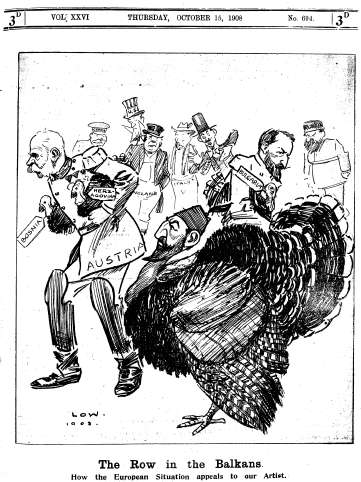
In October 1908, Austria-Hungary precipitated the Bosnian crisis of 1908–1909 by officially annexing the former Ottoman territory of Bosnia and Herzegovina, which it had occupied since 1878. This angered the Kingdom of Serbia and its patron, the Pan-Slavic and Orthodox Russian Empire. Russian political manoeuvring in the region destabilised peace accords that were already fracturing in the Balkans, which came to be known as the powder keg of Europe
In 1912 and 1913, the First Balkan War was fought between the Balkan League and the fracturing Ottoman Empire. The resulting Treaty of London further shrank the Ottoman Empire, creating an independent Albanian state while enlarging the territorial holdings of Bulgaria, Serbia, Montenegro, and Greece. When Bulgaria attacked Serbia and Greece on 16 June 1913, it sparked the 33-day Second Balkan War, by the end of which , further destabilising the region. The Great Powers were able to keep these Balkan conflicts contained, but the next one would spread throughout Europe and beyond.
Background
Political and military alliances
For much of the 19th century, the major European powers had tried to maintain a tenuous balance of power among themselves, resulting in a complex network of political and military alliances. The biggest challenges to this were Britains withdrawal into so-called splendid isolation, the decline of the Ottoman Empire and the post-1848 rise of Prussia under Otto von Bismarck. Victory in the 1866 Austro-Prussian War established Prussian hegemony in Germany, while victory over France in the 1870–1871 Franco-Prussian War unified the German states into a German Reich under Prussian leadership.In 1873, to isolate France and avoid a war on two fronts, Bismarck negotiated the League of the Three Emperors (German: Dreikaiserbund) between Austria-Hungary, Russia and Germany. Concerned by Russias victory in the 1877–1878 Russo-Turkish War and their influence in the Balkans, the League was dissolved in 1878, with Germany and Austria-Hungary subsequently forming the 1879 Dual Alliance; this became the Triple Alliance when Italy joined in 1882.The practical details of these alliances were limited, since their primary purpose was to ensure cooperation between the three Imperial Powers and isolate France. Attempts by Britain in 1880 to resolve colonial tensions with Russia and diplomatic moves by France led to Bismarck reforming the League in 1881. When the League finally lapsed in 1887, it was replaced by the Reinsurance Treaty, a secret agreement between Germany and Russia to remain neutral if either were attacked by France or Austria-Hungary.In 1890, the new German Emperor, Kaiser Wilhelm II, forced Bismarck to retire and was persuaded not to renew the Reinsurance Treaty by the new Chancellor, Leo von Caprivi. This allowed France to counteract the Triple Alliance with the Franco-Russian Alliance of 1894 and the 1904 Entente Cordiale with Britain, while in 1907 Britain and Russia signed the Anglo-Russian Convention. The agreements did not constitute formal alliances, but by settling long-standing colonial disputes, they made British entry into any future conflict involving France or Russia a possibility; these interlocking bilateral agreements became known as the Triple Entente
Arms race
The creation of the German Reich following victory in the 1871 Franco-Prussian War led to a massive increase in Germanys economic and industrial strength. Admiral Alfred von Tirpitz and Wilhelm II, who became Emperor in 1890, sought to use that to create a Kaiserliche Marine or Imperial German Navy to compete with Britains Royal Navy for world naval supremacy. In doing so, they were influenced by US naval strategist Alfred Mahan, who argued possession of a blue-water navy was vital for global power projection; Tirpitz translated his books into German and Wilhelm made them required reading. However, it was also driven by Wilhelms admiration of the Royal Navy and desire to outdo it.
SMS Rheinland, a Nassau-class battleship, Germanys first response to the British Dreadnought
This resulted in the Anglo-German naval arms race but the launch of HMS Dreadnought in 1906 gave the Royal Navy a technological advantage over its German rival, which they never lost. Ultimately, the race diverted huge resources to creating a German navy large enough to antagonise Britain, but not defeat it. In 1911, Chancellor Theobald von Bethmann-Hollweg acknowledged defeat, leading to the Rüstungswende or ‘armaments turning point, when Germany switched expenditure from the navy to the army.
This was driven by Russias recovery from the 1905 Revolution, specifically increased investment post 1908 in railways and infrastructure in its western border regions. Germany and Austria-Hungary relied on faster mobilisation to compensate for fewer numbers; it was concern at the closing of this gap that led to the end of the naval race, rather than a reduction in tension elsewhere. When Germany expanded its standing army by 170,000 men in 1913, France extended compulsory military service from two to three years; similar measures taken by the Balkan powers and Italy led to increased expenditure by the Ottomans and Austria-Hungary. Absolute figures are hard to calculate, due to differences in categorising expenditure, while they often omit civilian infrastructure projects with a military use, such as railways. However, from 1908 to 1913, defence spending by the six major European powers increased by over 50% in real terms
Conflicts in the Balkans
In October 1908, Austria-Hungary precipitated the Bosnian crisis of 1908–1909 by officially annexing the former Ottoman territory of Bosnia and Herzegovina, which it had occupied since 1878. This angered the Kingdom of Serbia and its patron, the Pan-Slavic and Orthodox Russian Empire. Russian political manoeuvring in the region destabilised peace accords that were already fracturing in the Balkans, which came to be known as the powder keg of Europe
In 1912 and 1913, the First Balkan War was fought between the Balkan League and the fracturing Ottoman Empire. The resulting Treaty of London further shrank the Ottoman Empire, creating an independent Albanian state while enlarging the territorial holdings of Bulgaria, Serbia, Montenegro, and Greece. When Bulgaria attacked Serbia and Greece on 16 June 1913, it sparked the 33-day Second Balkan War, by the end of which , further destabilising the region. The Great Powers were able to keep these Balkan conflicts contained, but the next one would spread throughout Europe and beyond.
Support
hermes79MarkuinComments (0)
 Facebook
 Instagram
 Discord
 Reddit