
World war I (part 6) | Tweet
Published in Greece  - Social interactions and entertainment - 0 - 11 Feb 20 23:44
Continuation of trench warfare
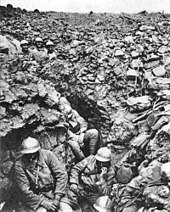
Neither side proved able to deliver a decisive blow for the next two years. Throughout 1915–17, the British Empire and France suffered more casualties than Germany, because of both the strategic and tactical stances chosen by the sides. Strategically, while the Germans mounted only one major offensive, the Allies made several attempts to break through the German lines.In February 1916 the Germans attacked French defensive positions at the Battle of Verdun, lasting until December 1916. The Germans made initial gains, before French counter-attacks returned matters to near their starting point. Casualties were greater for the French, but the Germans bled heavily as well, with anywhere from 700,000[ to 975,000 casualties suffered between the two combatants. Verdun became a symbol of French determination and self-sacrifice.
The Battle of the Somme was an Anglo-French offensive of July to November 1916. The opening day of the offensive (1 July 1916) was the bloodiest day in the history of the British Army, suffering 57,470 casualties, including 19,240 dead. The entire Somme offensive cost the British Army some 420,000 casualties. The French suffered another estimated 200,000 casualties and the Germans an estimated 500,000.
 
 Gun fire was not the only factor taking lives; the diseases that emerged in the trenches were a major killer on both sides. The living conditions made it so that countless diseases and infections occurred, such as trench foot, shell shock, blindness/burns from mustard gas, lice, trench fever, cooties (body lice) and the Spanish Flu.
To maintain morale, wartime censors minimised early reports of widespread influenza illness and mortality in Germany, the United Kingdom, France, and the United States. Papers were free to report the epidemics effects in neutral Spain (such as the grave illness of King Alfonso XIII). This created a false impression of Spain as especially hard hit, thereby giving rise to the pandemics nickname, Spanish Flu.
Protracted action at Verdun throughout 1916, combined with the bloodletting at the Somme, brought the exhausted French army to the brink of collapse. Futile attempts using frontal assault came at a high price for both the British and the French and led to the widespread French Army Mutinies, after the failure of the costly Nivelle Offensive of April–May 1917. The concurrent British Battle of Arras was more limited in scope, and more successful, although ultimately of little strategic value. A smaller part of the Arras offensive, the capture of Vimy Ridge by the Canadian Corps, became highly significant to that country: the idea that Canadas national identity was born out of the battle is an opinion widely held in military and general histories of Canada.
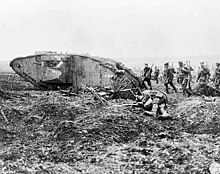 
The last large-scale offensive of this period was a British attack (with French support) at Passchendaele (July–November 1917). This offensive opened with great promise for the Allies, before bogging down in the October mud. Casualties, though disputed, were roughly equal, at some 200,000–400,000 per side.The years of trench warfare on the Western front achieved no major exchanges of territory and, as a result, are often thought of as static and unchanging. However, throughout this period, British, French, and German tactics constantly evolved to meet new battlefield challenges.
Naval war
At the start of the war, the German Empire had cruisers scattered across the globe, some of which were subsequently used to attack Allied merchant shipping.

The British Royal Navy systematically hunted them down, though not without some embarrassment from its inability to protect Allied shipping. Before the beginning of the war, it was widely understood that Britain held the position of strongest, most influential navy in the world. he publishing of the book The Influence of Sea Power upon History by Alfred Thayer Mahan in 1890 was intended to encourage the United States to increase their naval power. Instead, this book made it to Germany and inspired its readers to try to over-power the British Royal Navy. For example, the German detached light cruiser SMS Emden, part of the East Asia Squadron stationed at Qingdao, seized or destroyed 15 merchantmen, as well as sinking a Russian cruiser and a French destroyer. However, most of the German East-Asia squadron—consisting of the armoured cruisers SMS Scharnhorst and Gneisenau, light cruisers Nürnberg and Leipzig and two transport ships—did not have orders to raid shipping and was instead underway to Germany when it met British warships. The German flotilla and Dresden sank two armoured cruisers at the Battle of Coronel, but was virtually destroyed at the Battle of the Falkland Islands in December 1914, with only Dresden and a few auxiliaries escaping, but after the Battle of Más a Tierra these too had been destroyed or interned.
 
Soon after the outbreak of hostilities, Britain began a naval blockade of Germany. The strategy proved effective, cutting off vital military and civilian supplies, although this blockade violated accepted international law codified by several international agreements of the past two centuries.  Britain mined international waters to prevent any ships from entering entire sections of ocean, causing danger to even neutral ships.
Since there was limited response to this tactic of the British, Germany expected a similar response to its unrestricted submarine warfare.Â
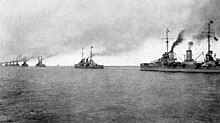
The Battle of Jutland (German: Skagerrakschlacht, or Battle of the Skagerrak) in May/June 1916 developed into the largest naval battle of the war. It was the only full-scale clash of battleships during the war, and one of the largest in history. The Kaiserliche Marines High Seas Fleet, commanded by Vice Admiral Reinhard Scheer, fought the Royal Navys Grand Fleet, led by Admiral Sir John Jellicoe. The engagement was a stand off, as the Germans were outmanoeuvred by the larger British fleet, but managed to escape and inflicted more damage to the British fleet than they received. Strategically, however, the British asserted their control of the sea, and the bulk of the German surface fleet remained confined to port for the duration of the war.
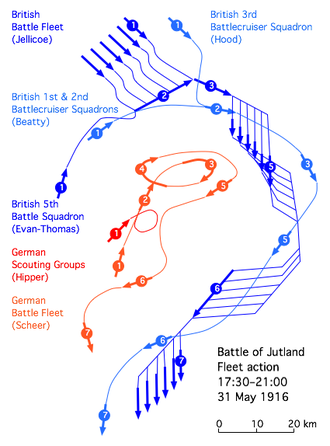
(1) 18:00 Scouting forces rejoin their respective fleets.
(2) 18:15 British fleet deploys into battle line
(3) 18:30 German fleet under fire turns away
(4) 19:00 German fleet turns back
(5) 19:15 German fleet turns away for second time
(6) 20:00
(7) 21:00 Nightfall: Jellicoe assumes night cruising formation
German U-boats attempted to cut the supply lines between North America and Britain. The nature of submarine warfare meant that attacks often came without warning, giving the crews of the merchant ships little hope of survival. The United States launched a protest, and Germany changed its rules of engagement. After the sinking of the passenger ship RMS Lusitania in 1915, Germany promised not to target passenger liners, while Britain armed its merchant ships, placing them beyond the protection of the cruiser rules, which demanded warning and movement of crews to a place of safety (a standard that lifeboats did not meet). Finally, in early 1917, Germany adopted a policy of unrestricted submarine warfare, realising the Americans would eventually enter the war. Germany sought to strangle Allied sea lanes before the United States could transport a large army overseas, but after initial successes eventually failed to do so.
 
The U-boat threat lessened in 1917, when merchant ships began travelling in convoys, escorted by destroyers. This tactic made it difficult for U-boats to find targets, which significantly lessened losses; after the hydrophone and depth charges were introduced, accompanying destroyers could attack a submerged submarine with some hope of success. Convoys slowed the flow of supplies, since ships had to wait as convoys were assembled. The solution to the delays was an extensive program of building new freighters. Troopships were too fast for the submarines and did not travel the North Atlantic in convoys.  The U-boats had sunk more than 5,000 Allied ships, at a cost of 199 submarines.World War I also saw the first use of aircraft carriers in combat, with HMS Furious launching Sopwith Camels in a successful raid against the Zeppelin hangars at Tondern in July 1918, as well as blimps for antisubmarine patrol.
Neither side proved able to deliver a decisive blow for the next two years. Throughout 1915–17, the British Empire and France suffered more casualties than Germany, because of both the strategic and tactical stances chosen by the sides. Strategically, while the Germans mounted only one major offensive, the Allies made several attempts to break through the German lines.In February 1916 the Germans attacked French defensive positions at the Battle of Verdun, lasting until December 1916. The Germans made initial gains, before French counter-attacks returned matters to near their starting point. Casualties were greater for the French, but the Germans bled heavily as well, with anywhere from 700,000[ to 975,000 casualties suffered between the two combatants. Verdun became a symbol of French determination and self-sacrifice.
The Battle of the Somme was an Anglo-French offensive of July to November 1916. The opening day of the offensive (1 July 1916) was the bloodiest day in the history of the British Army, suffering 57,470 casualties, including 19,240 dead. The entire Somme offensive cost the British Army some 420,000 casualties. The French suffered another estimated 200,000 casualties and the Germans an estimated 500,000.
 Gun fire was not the only factor taking lives; the diseases that emerged in the trenches were a major killer on both sides. The living conditions made it so that countless diseases and infections occurred, such as trench foot, shell shock, blindness/burns from mustard gas, lice, trench fever, cooties (body lice) and the Spanish Flu.
To maintain morale, wartime censors minimised early reports of widespread influenza illness and mortality in Germany, the United Kingdom, France, and the United States. Papers were free to report the epidemics effects in neutral Spain (such as the grave illness of King Alfonso XIII). This created a false impression of Spain as especially hard hit, thereby giving rise to the pandemics nickname, Spanish Flu.
Protracted action at Verdun throughout 1916, combined with the bloodletting at the Somme, brought the exhausted French army to the brink of collapse. Futile attempts using frontal assault came at a high price for both the British and the French and led to the widespread French Army Mutinies, after the failure of the costly Nivelle Offensive of April–May 1917. The concurrent British Battle of Arras was more limited in scope, and more successful, although ultimately of little strategic value. A smaller part of the Arras offensive, the capture of Vimy Ridge by the Canadian Corps, became highly significant to that country: the idea that Canadas national identity was born out of the battle is an opinion widely held in military and general histories of Canada.
The last large-scale offensive of this period was a British attack (with French support) at Passchendaele (July–November 1917). This offensive opened with great promise for the Allies, before bogging down in the October mud. Casualties, though disputed, were roughly equal, at some 200,000–400,000 per side.The years of trench warfare on the Western front achieved no major exchanges of territory and, as a result, are often thought of as static and unchanging. However, throughout this period, British, French, and German tactics constantly evolved to meet new battlefield challenges.
Naval war
At the start of the war, the German Empire had cruisers scattered across the globe, some of which were subsequently used to attack Allied merchant shipping.
The British Royal Navy systematically hunted them down, though not without some embarrassment from its inability to protect Allied shipping. Before the beginning of the war, it was widely understood that Britain held the position of strongest, most influential navy in the world. he publishing of the book The Influence of Sea Power upon History by Alfred Thayer Mahan in 1890 was intended to encourage the United States to increase their naval power. Instead, this book made it to Germany and inspired its readers to try to over-power the British Royal Navy. For example, the German detached light cruiser SMS Emden, part of the East Asia Squadron stationed at Qingdao, seized or destroyed 15 merchantmen, as well as sinking a Russian cruiser and a French destroyer. However, most of the German East-Asia squadron—consisting of the armoured cruisers SMS Scharnhorst and Gneisenau, light cruisers Nürnberg and Leipzig and two transport ships—did not have orders to raid shipping and was instead underway to Germany when it met British warships. The German flotilla and Dresden sank two armoured cruisers at the Battle of Coronel, but was virtually destroyed at the Battle of the Falkland Islands in December 1914, with only Dresden and a few auxiliaries escaping, but after the Battle of Más a Tierra these too had been destroyed or interned.
Soon after the outbreak of hostilities, Britain began a naval blockade of Germany. The strategy proved effective, cutting off vital military and civilian supplies, although this blockade violated accepted international law codified by several international agreements of the past two centuries.  Britain mined international waters to prevent any ships from entering entire sections of ocean, causing danger to even neutral ships.
Since there was limited response to this tactic of the British, Germany expected a similar response to its unrestricted submarine warfare.Â
The Battle of Jutland (German: Skagerrakschlacht, or Battle of the Skagerrak) in May/June 1916 developed into the largest naval battle of the war. It was the only full-scale clash of battleships during the war, and one of the largest in history. The Kaiserliche Marines High Seas Fleet, commanded by Vice Admiral Reinhard Scheer, fought the Royal Navys Grand Fleet, led by Admiral Sir John Jellicoe. The engagement was a stand off, as the Germans were outmanoeuvred by the larger British fleet, but managed to escape and inflicted more damage to the British fleet than they received. Strategically, however, the British asserted their control of the sea, and the bulk of the German surface fleet remained confined to port for the duration of the war.
(1) 18:00 Scouting forces rejoin their respective fleets.
(2) 18:15 British fleet deploys into battle line
(3) 18:30 German fleet under fire turns away
(4) 19:00 German fleet turns back
(5) 19:15 German fleet turns away for second time
(6) 20:00
(7) 21:00 Nightfall: Jellicoe assumes night cruising formation
German U-boats attempted to cut the supply lines between North America and Britain. The nature of submarine warfare meant that attacks often came without warning, giving the crews of the merchant ships little hope of survival. The United States launched a protest, and Germany changed its rules of engagement. After the sinking of the passenger ship RMS Lusitania in 1915, Germany promised not to target passenger liners, while Britain armed its merchant ships, placing them beyond the protection of the cruiser rules, which demanded warning and movement of crews to a place of safety (a standard that lifeboats did not meet). Finally, in early 1917, Germany adopted a policy of unrestricted submarine warfare, realising the Americans would eventually enter the war. Germany sought to strangle Allied sea lanes before the United States could transport a large army overseas, but after initial successes eventually failed to do so.
The U-boat threat lessened in 1917, when merchant ships began travelling in convoys, escorted by destroyers. This tactic made it difficult for U-boats to find targets, which significantly lessened losses; after the hydrophone and depth charges were introduced, accompanying destroyers could attack a submerged submarine with some hope of success. Convoys slowed the flow of supplies, since ships had to wait as convoys were assembled. The solution to the delays was an extensive program of building new freighters. Troopships were too fast for the submarines and did not travel the North Atlantic in convoys.  The U-boats had sunk more than 5,000 Allied ships, at a cost of 199 submarines.World War I also saw the first use of aircraft carriers in combat, with HMS Furious launching Sopwith Camels in a successful raid against the Zeppelin hangars at Tondern in July 1918, as well as blimps for antisubmarine patrol.
Support
Comments (0)
 Facebook
 Instagram
 Discord
 Reddit