SOME BEAUTIFUL PLACES IN GEORGIA | Tweet
Published in Georgia  - Social interactions and entertainment - 10 - 11 Apr 20 07:43
Katskhi pillar - კáƒáƒªáƒ®áƒ˜áƒ¡ სვეტი
 
In historical records, the Katskhi pillar is first mentioned by the 18th-century Georgian scholar Prince Vakhushti, who reports in his Geographic Deion of the Kingdom of Georgia: There is a rock within the ravine standing like a pillar, considerably high. There is a small church on the top of the rock, but nobody is able to ascend it; nor know they how to do that.No other written accounts of monastic life or ascents survive. A number of local legends surround the pillar. One of them has it that the top of the rock was connected by a long iron chain to the dome of the Katskhi church, located at a distance of around 1.5 km from the pillar.
In July 1944 a group led by the mountaineer Alexander Japaridze and the writer Levan Gotua made the first documented ascent of the Katskhi pillar. Vakhtang Tsintsadze, an architecture specialist with the group, reported in his 1946 paper that the ruins found on top of the rock were remains of two churches, dating from the 5th and 6th centuries and associated with a stylite practice, a form of Christian asceticism. Since 1999, the Katskhi pillar has become the subject of more systematic research. Based on further studies and archaeological digs conducted in 2006, Giorgi Gagoshidze, an art historian with the Georgian National Museum, re-dated the structures to the 9th–10th century. He concluded that this complex was composed of a monastery church and cells for hermits. Discovery of the remnants of a wine cellar also undermined the idea of extreme ascetism flourishing on the pillar. In 2007, a small limestone plate with the asomtavruli Georgian inions was found, paleographically dated to the 13th century and revealing the name of a certain Giorgi, responsible for the construction of three hermit cells. The inion also makes mention of the Pillar of Life, echoing the popular tradition of veneration of the rock as a symbol of the True Cross.
Religious activity started to revive in 1995, with the arrival of the monk Maxim Qavtaradze, a native of Chiatura.Between 2005 and 2009, the monastery building on the top of the pillar was restored with the support of the National Agency for Cultural Heritage Preservation of Georgia.The rock was once accessible to male visitors through an iron ladder running from its base to the top, but has recently been deemed inaccessible to the public.
Maxime Qavtaradze, a monk of the Orthodox Church, has lived on top of Katskhi Pillar for 20 years, coming down only twice a week. Evidence of use by stylites as late as the 13th century has been found on the top of the rock. With the aid of local villagers and the National Agency for Cultural Heritage Preservation of Georgia, Qavtaradze restored the 1200-year-old monastic chapel on the top of the rock. A film documentary on the project was completed in 2013.
Bagrati Cathedral - ბáƒáƒ’რáƒáƒ¢áƒ˜áƒ¡ ტáƒáƒ«áƒáƒ ი
 
The Cathedral of the Dormition, or the Kutaisi Cathedral, more commonly known as Bagrati Cathedral (Georgian: ბáƒáƒ’რáƒáƒ¢áƒ˜; ბáƒáƒ’რáƒáƒ¢áƒ˜áƒ¡ ტáƒáƒ«áƒáƒ ი, or Bagratis tadzari), is an 11th-century cathedral in the city of Kutaisi, in the Imereti region of Georgia. A masterpiece of the medieval Georgian architecture, the cathedral suffered heavy damage throughout centuries and was reconstructed to its present state through a gradual process starting in the 1950s, with major conservation works concluding in 2012. A distinct landmark in the scenery of central Kutaisi, the cathedral rests on the Ukimerioni Hill.
Bagrati Cathedral was built in the early years of the 11th century, during the reign of King Bagrat III, due to which it was called Bagrati, i.e., Bagrat’s cathedral. An inion on the north wall reveals that the floor was laid in chronicon 223, i.e., 1003. In 1692, it was devastated in an explosion by Ottoman troops who had invaded the Kingdom of Imereti. The incident caused the cupola and ceiling to collapse.Conservation and restoration works, as well as archaeological studies at the Cathedral began in the 1950s under the leadership of a Georgian architect Vakhtang Tsintsadze. The restoration works headed by Tsintsadze were divided into six stages and continued for several decades through 1994.That same year in 1994 Bagrati Cathedral, together with the Gelati Monastery, was included in UNESCOs World Heritage Site list as a single entity. In 2001, ownership of the cathedral was transferred from the Georgian state to the Georgian Orthodox Church. It is presently of limited use for religious services, but attracts many pilgrims and tourists. It is also frequently used as a symbol of the city of Kutaisi, being one of its main tourist attractions.
Alaverdi Monastery - áƒáƒšáƒáƒ•áƒ”რდის მáƒáƒœáƒáƒ¡áƒ¢áƒ”რი
 
Alaverdi Monastery (Georgian: áƒáƒšáƒáƒ•áƒ”რდის მáƒáƒœáƒáƒ¡áƒ¢áƒ”რი) is a Georgian Eastern Orthodox monastery located 25 km (16 mi) from Akhmeta, in the Kakheti region of Eastern Georgia. While parts of the monastery date back to 6th century, the present day cathedral was built in the 11th century by Kvirike III of Kakheti, replacing an older church of St. George.
The monastery was founded by the Assyrian monk Joseph (Yoseb, Amba) Alaverdeli, who came from Antioch and settled in Alaverdi, then a small village and former pagan religious center dedicated to the Moon. At a height of over 55 m (180 ft), Alaverdi Cathedral was the tallest religious building in Georgia, until the construction of the Holy Trinity Cathedral of Tbilisi, which was consecrated in 2004. However its overall size is smaller than the cathedral of Svetitskhoveli in Mtskheta. The monastery is the focus of the annual religious celebration Alaverdoba. Situated in the heart of the worlds oldest wine region, the monks also make their own wine, known as Alaverdi Monastery Cellar.
Rabati Castle - რáƒáƒ‘áƒáƒ—ის ციხე
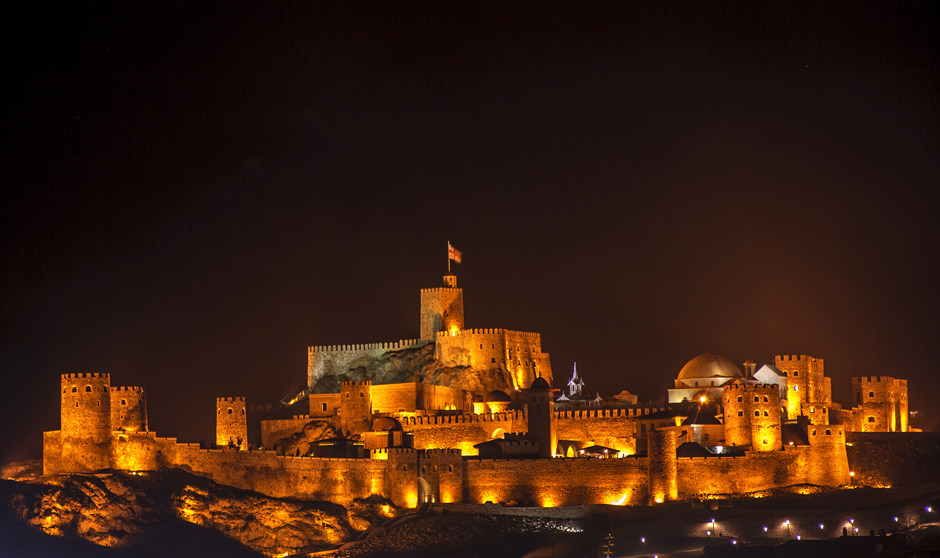
Rabati Castle (Georgian: რáƒáƒ‘áƒáƒ—ის ციხე) is a medieval fortress built in the 9th century under the name Lomisa Castle in the city of Akhaltsikhe in southern Georgia, recently globally reconstructed. One of the main attractions of the Samtskhe-Javakheti region along with Vardzia
According to the Georgian Chronicles the city was established in the 9th century by Guaram Mampal, son of the King of Tao , at the end of the 12th century Lomisa turned into a real city with the new name Akhal-tsikhe (New Fortress), which in addition to the fortress had a serious system of city-wide fortifications - high walls, guarded entrance gates and watch towers. From the 13th to the end of 14th centuries it was the capital city of Samtskhe-Saatabago, ruled by the Georgian princely (mtavari) family and a ruling dynasty of the Principality of Samtskhe, the House of Jaqeli.
In 1393 the city was attacked by the armies of Tamerlane. Despite the Turko-Mongol invasions, the fortress withstood and continued to thrive. After the Treaty of Constantinople in 1590, the whole territory of Samtskhe-Saatabago came under the rule of Ottoman Empire. Turks Mostly used to build defensive edifices. In 1752 the first mosque was built in Rabati.
Metropolitan John writes in the late 18th century that despite the fact that a large part of the population has been Islamized, theres still a functioning Orthodox church. After the Treaty of Georgievsk between the Kingdom of Kartli and the Russian Empire was signed, the question of the fate of Akhaltsikhe arose. The first attempt to take the fortress in 1810 failed. Prince Paskevich successfully stormed the fortress 18 years later, in the great Battle of Akhalzic. After the Treaty of Adrianople in 1829, the Ottomans yielded part of Akhaltiske Region.
The fortress and its adjacent buildings were extensively rebuilt and renovated in 2011-2012 in order to attract more tourists to the area.
Holy Trinity Cathedral of Tbilisi - წმინდრსáƒáƒ›áƒ”ბის სáƒáƒ™áƒáƒ—ედრრტáƒáƒ«áƒáƒ ი
 
The Holy Trinity Cathedral of Tbilisi (Georgian: თბილისის წმინდრსáƒáƒ›áƒ”ბის სáƒáƒ™áƒáƒ—ედრრტáƒáƒ«áƒáƒ ი Tbilisis cminda samebis sakatedro tadzari), commonly known as Sameba (Georgian: სáƒáƒ›áƒ”ბის ლáƒáƒ•áƒ რfor Trinity), is the main cathedral of the Georgian Orthodox Church located in Tbilisi, the capital of Georgia. Constructed between 1995 and 2004, it is the third-tallest Eastern Orthodox cathedral in the world and one of the largest religious buildings in the world by total area. Sameba is a synthesis of traditional styles dominating the Georgian church architecture at various stages in history and has some Byzantine undertones.
The idea to build a new cathedral to commemorate 1,500 years of autocephaly of the Georgian Orthodox Church and 2,000 years from the birth of Jesus emerged as early as 1989, a crucial year for the national awakening of the then-Soviet republic of Georgia. In May 1989, the Georgian Orthodox Patriarchate and the authorities of Tbilisi announced an international contest for the Holy Trinity Cathedral project. No winner was chosen at the first round of the contest when more than a hundred projects were submitted. Finally the design by architect Archil Mindiashvili won. The subsequent turbulent years of civil unrest in Georgia deferred this grandiose plan for six years, and it was not until November 23, 1995, that the foundation of the new cathedral was laid.
The construction of the church was proclaimed as a symbol of the Georgian national and spiritual revival and was sponsored mostly by anonymous donations from several businessmen and common citizens. On November 23, 2004, on St. Georges Day, the cathedral was consecrated by Catholicos Patriarch of Georgia Ilia II and high-ranking representatives of fellow Orthodox Churches of the world. The ceremony was also attended by leaders of other religious and confessional communities in Georgia as well as by political leaders.
At least part of the site chosen for the new cathedral complex included land within what had once been an old Armenian cemetery called Khojavank.The cemetery once had an Armenian church destroyed during the Soviet period by the orders of Lavrenti Beria. Most of the cemeterys gravestones and monuments were also destroyed and the cemetery turned into a recreational park. However, the cemetery still contained many of its graves when construction of the Sameba Cathedral commenced. The cemetery was treated with a scandalous lack of respect according to one author,after bones and gravestones appeared scattered all over the construction site.
SIGNAGI - სიღნáƒáƒ¦áƒ˜
 
Signagi or Sighnaghi (Georgian: სიღნáƒáƒ¦áƒ˜) is a town in Georgias easternmost region of Kakheti and the administrative center of the Signagi Municipality. Although it is one of Georgias smallest towns, Signagi serves as a popular tourist destination due to its location at the heart of Georgias wine-growing regions, as well as its picturesque landscapes, pastel houses and narrow, cobblestone streets. Located on a steep hill, Signagi overlooks the vast Alazani Valley, with the Caucasus Mountains visible at a distance.
Signagi is located in the Kakheti region of Georgia, first settled in the Paleolithic period. Throughout its history Signagi or Sighnaghi was known to the local population as Kambechovani, and later as Kisikhi or Kisiki. The word Sighnaghi in the Turkic language means shelter or trench. Signagi as a settlement was first recorded in the early 18th century. In 1762, King Heraclius II of Georgia sponsored the construction of the town and erected a fortress to defend the area from marauding attacks by Dagestani tribesmen.
According to the 1770 census, 100 families, chiefly craftsmen and merchants, lived in Signagi. When Georgia was annexed by Imperial Russia in 1801, Signagi (Signakh) was officially granted town status and became a centre of the Signakh uyezd (Russian: СигнахÑкий уезд) within the Tiflis Governorate in 1802. In 1812, Signakh joined the rebellion with the rest of Kakheti against Russian rule. During the Caucasian War, the town was considered an important point on account of its proximity to Dagestan.
The town quickly grew in size and population and became an agricultural center in the Soviet Union. The severe economic crisis in post-Soviet Georgia heavily affected the town, but a major reconstruction project recently launched by the Government of Georgia and co-funded by several international organizations intends to both address an increasing tourist interest and modernize infrastructure.
Batumi - ბáƒáƒ—უმი
 
Batumi (/bÉ‘ËˈtuËmi/; Georgian: ბáƒáƒ—უმი ) is the capital of the Autonomous Republic of Adjara and the second largest city of Georgia, located on the coast of the Black Sea in the countrys southwest. It is situated in a Subtropical Zone at the foot of Caucasus. Much of Batumis economy revolves around tourism and gambling (It is nicknamed The Las Vegas of the Black Sea), but the city is also an important sea port and includes industries like shipbuilding, food processing and light manufacturing. Since 2010, Batumi has been transformed by the construction of modern high-rise buildings, as well as the restoration of l 19th-century edifices lining its historic Old Town.
Early history
Batumi is located on the site of the ancient Greek colony in Colchis called Bathus or Bathys – derived from (Greek: βαθÏÏ‚ λιμεν, bathus limen; or βαθÏÏ‚ λιμήν, bathys limÄ“n; lit. the deep harbor). Under Hadrian (c. 117–138 AD), it was converted into a fortified Roman port and later deserted for the fortress of Petra founded in the time of Justinian I (c. 527–565). Garrisoned by the Roman-Byzantine forces, it was formally a possession of the kingdom of Lazica until being occupied briefly by the Arabs, who did not hold it; In 780 Lazica fell to kingdom of Abkhazia via a dynastic union, the later led the unification of Georgian monarchy in the 11th century.
From 1010, it was governed by the eristavi (ერისთáƒáƒ•áƒ˜, viceroy) of the king of Georgia. In the late 15th century, after the disintegration of the Georgian kingdom, Batumi passed to the princes (mtavari, მთáƒáƒ•áƒáƒ ი) of Guria, a western Georgian principality under the sovereignty of the kings of Imereti.
A curious incident occurred in 1444 when a Burgundian flotilla, after a failed crusade against the Ottoman Empire, penetrated the Black Sea and engaged in piracy along its eastern coastline until the Burgundians under the knight Geoffroy de Thoisy were ambushed while landing to raid Vaty, as Europeans then knew Batumi. De Thoisy was taken captive and released through the mediation of the emperor John IV of Trebizond.
Ottoman ruleIn the 15th century in the reign of the prince Kakhaber Gurieli, the Ottoman Turks conquered the town and its district but did not hold them. They returned to it in force a century later and inflicted a decisive defeat on the Georgian armies at Sokhoista. Batumi was recaptured by the Georgians several times, first in 1564 by prince Rostom Gurieli, who lost it soon afterwards, and again in 1609 by Mamia II Gurieli. In 1614, Batumi again became part of the Ottoman Empire. In the two-and-a-half centuries of Ottoman rule it grew into a provincial port serving the Empires hinterlands on the eastern fringes of the Black Sea. After the Turkish conquest Islamisation of the hitherto Christian region began but this was terminated and to a great degree reversed, after the area was re-annexed to Russian Imperial Georgia after the Russo-Turkish War of 1877–78.
Imperial Russian rule
Detail from a map of Antonio Zatta, 1784, depicting Georgian principality of Guria and its major town Batumi.
Port of Batumi in 1881It was the last Black Sea port annexed by Russia during the Russian conquest of that area of the Caucasus. In 1878, Batumi was annexed by the Russian Empire in accordance with the Treaty of San Stefano between Russia and the Ottoman Empire (ratified on March 23) . Occupied by the Russians on August 28, 1878, the town was declared a free port until 1886. It functioned as the center of a special military district until being incorporated in the Government of Kutaisi on June 12, 1883. Finally, on June 1, 1903, with the Okrug of Artvin, it was established as the region (oblast) of Batumi and placed under the direct control of the General Government of Georgia.
The expansion of Batumi began in 1883 with the construction of the Batumi–Tiflis–Baku railway (completed in 1900) and the finishing of the Baku–Batumi pipeline. Henceforth, Batumi became the chief Russian oil port in the Black Sea. The town population increased rapidly doubling within 20 years: from 8,671 inhabitants in 1882 to 12,000 in 1889. By 1902 the population had reached 16,000, with 1,000 working in the refinery for Baron Rothschilds Caspian and Black Sea oil company.
In the late 1880s and after, more than 7,400 Doukhobor emigrants sailed for Canada from Batumi, after the government agreed to let them emigrate. Quakers and Tolstoyans aided in collecting funds for the relocation of the religious minority, which had come into conflict with the Imperial government over its refusal to serve in the military and other positions. Canada settled them in Manitoba and Saskatchewan.
War, communism, and late 20th-century independenceDuring 1901, sixteen years prior to the October Revolution, Joseph Stalin, the future leader of the Soviet Union, lived in the city organizing strikes. On March 3, 1918, the Treaty of Brest-Litovsk gave the city back to the Ottoman Empire; unrest during the closing weeks of World War I led to the re-entry of Turkish forces in April 1918, followed in December by British forces, who stayed until July 1920. Kemal Atatürk ceded the area to the Bolsheviks of the Soviet Union on the condition that it be granted autonomy, for the sake of the Muslims among Batumis mixed population.
When Georgia gained its independence from the Soviet Union in 1989, Aslan Abashidze was appointed head of Adjaras governing council and subsequently held onto power throughout the unrest of the 1990s. Whilst other regions, such as Abkhazia, attempted to break away from the Georgian state, Adjara remained as an integral part of the Republics territory. In May 2004, he fled to Russia because of mass protests in Tbilisi sparked by the Rose Revolution.
Present day
Batumi today is one of the main port cities of Georgia. It has the capacity for 80,000-ton tankers to take materials such as oil that are shipped through Georgia from Central Asia. Additionally, the city exports regional agricultural products. Since 1995 the freight conversion of the port has constantly risen, with an approximate 8 million tons in 2001. The annual revenue from the port is estimated at between $200 million and $300 million.
Since the change of power in Adjara, Batumi has attracted international investors, and the prices of real estate in the city have trebled since 2001. In July 2007, the seat of the Constitutional Court of Georgia was moved from Tbilisi to Batumi to stimulate regional development. Several new hotels opened after 2009, first the Sheraton in 2010 and the Radisson Blu in 2011. The city features several casinos that attract tourists from Turkey, where gambling is illegal.
Batumi was host to the Russian 12th Military Base. Following the Rose Revolution, the central government pushed for the removal of these forces and reached agreement in 2005 with Moscow. According to the agreement, the process of withdrawal was planned to be completed in 2008, but the Russians completed the transfer of the Batumi base to Georgia on November 13, 2007, ahead of schedule.
In 2013, TAM GEO LLC announced it was investing $70 million to start construction of the 170-meter, 45-story mix-use complex Babillon Tower, which will be the tallest residential building in Georgia.
In historical records, the Katskhi pillar is first mentioned by the 18th-century Georgian scholar Prince Vakhushti, who reports in his Geographic Deion of the Kingdom of Georgia: There is a rock within the ravine standing like a pillar, considerably high. There is a small church on the top of the rock, but nobody is able to ascend it; nor know they how to do that.No other written accounts of monastic life or ascents survive. A number of local legends surround the pillar. One of them has it that the top of the rock was connected by a long iron chain to the dome of the Katskhi church, located at a distance of around 1.5 km from the pillar.
In July 1944 a group led by the mountaineer Alexander Japaridze and the writer Levan Gotua made the first documented ascent of the Katskhi pillar. Vakhtang Tsintsadze, an architecture specialist with the group, reported in his 1946 paper that the ruins found on top of the rock were remains of two churches, dating from the 5th and 6th centuries and associated with a stylite practice, a form of Christian asceticism. Since 1999, the Katskhi pillar has become the subject of more systematic research. Based on further studies and archaeological digs conducted in 2006, Giorgi Gagoshidze, an art historian with the Georgian National Museum, re-dated the structures to the 9th–10th century. He concluded that this complex was composed of a monastery church and cells for hermits. Discovery of the remnants of a wine cellar also undermined the idea of extreme ascetism flourishing on the pillar. In 2007, a small limestone plate with the asomtavruli Georgian inions was found, paleographically dated to the 13th century and revealing the name of a certain Giorgi, responsible for the construction of three hermit cells. The inion also makes mention of the Pillar of Life, echoing the popular tradition of veneration of the rock as a symbol of the True Cross.
Religious activity started to revive in 1995, with the arrival of the monk Maxim Qavtaradze, a native of Chiatura.Between 2005 and 2009, the monastery building on the top of the pillar was restored with the support of the National Agency for Cultural Heritage Preservation of Georgia.The rock was once accessible to male visitors through an iron ladder running from its base to the top, but has recently been deemed inaccessible to the public.
Maxime Qavtaradze, a monk of the Orthodox Church, has lived on top of Katskhi Pillar for 20 years, coming down only twice a week. Evidence of use by stylites as late as the 13th century has been found on the top of the rock. With the aid of local villagers and the National Agency for Cultural Heritage Preservation of Georgia, Qavtaradze restored the 1200-year-old monastic chapel on the top of the rock. A film documentary on the project was completed in 2013.
Bagrati Cathedral - ბáƒáƒ’რáƒáƒ¢áƒ˜áƒ¡ ტáƒáƒ«áƒáƒ ი
The Cathedral of the Dormition, or the Kutaisi Cathedral, more commonly known as Bagrati Cathedral (Georgian: ბáƒáƒ’რáƒáƒ¢áƒ˜; ბáƒáƒ’რáƒáƒ¢áƒ˜áƒ¡ ტáƒáƒ«áƒáƒ ი, or Bagratis tadzari), is an 11th-century cathedral in the city of Kutaisi, in the Imereti region of Georgia. A masterpiece of the medieval Georgian architecture, the cathedral suffered heavy damage throughout centuries and was reconstructed to its present state through a gradual process starting in the 1950s, with major conservation works concluding in 2012. A distinct landmark in the scenery of central Kutaisi, the cathedral rests on the Ukimerioni Hill.
Bagrati Cathedral was built in the early years of the 11th century, during the reign of King Bagrat III, due to which it was called Bagrati, i.e., Bagrat’s cathedral. An inion on the north wall reveals that the floor was laid in chronicon 223, i.e., 1003. In 1692, it was devastated in an explosion by Ottoman troops who had invaded the Kingdom of Imereti. The incident caused the cupola and ceiling to collapse.Conservation and restoration works, as well as archaeological studies at the Cathedral began in the 1950s under the leadership of a Georgian architect Vakhtang Tsintsadze. The restoration works headed by Tsintsadze were divided into six stages and continued for several decades through 1994.That same year in 1994 Bagrati Cathedral, together with the Gelati Monastery, was included in UNESCOs World Heritage Site list as a single entity. In 2001, ownership of the cathedral was transferred from the Georgian state to the Georgian Orthodox Church. It is presently of limited use for religious services, but attracts many pilgrims and tourists. It is also frequently used as a symbol of the city of Kutaisi, being one of its main tourist attractions.
Alaverdi Monastery - áƒáƒšáƒáƒ•áƒ”რდის მáƒáƒœáƒáƒ¡áƒ¢áƒ”რი
Alaverdi Monastery (Georgian: áƒáƒšáƒáƒ•áƒ”რდის მáƒáƒœáƒáƒ¡áƒ¢áƒ”რი) is a Georgian Eastern Orthodox monastery located 25 km (16 mi) from Akhmeta, in the Kakheti region of Eastern Georgia. While parts of the monastery date back to 6th century, the present day cathedral was built in the 11th century by Kvirike III of Kakheti, replacing an older church of St. George.
The monastery was founded by the Assyrian monk Joseph (Yoseb, Amba) Alaverdeli, who came from Antioch and settled in Alaverdi, then a small village and former pagan religious center dedicated to the Moon. At a height of over 55 m (180 ft), Alaverdi Cathedral was the tallest religious building in Georgia, until the construction of the Holy Trinity Cathedral of Tbilisi, which was consecrated in 2004. However its overall size is smaller than the cathedral of Svetitskhoveli in Mtskheta. The monastery is the focus of the annual religious celebration Alaverdoba. Situated in the heart of the worlds oldest wine region, the monks also make their own wine, known as Alaverdi Monastery Cellar.
Rabati Castle - რáƒáƒ‘áƒáƒ—ის ციხე
Rabati Castle (Georgian: რáƒáƒ‘áƒáƒ—ის ციხე) is a medieval fortress built in the 9th century under the name Lomisa Castle in the city of Akhaltsikhe in southern Georgia, recently globally reconstructed. One of the main attractions of the Samtskhe-Javakheti region along with Vardzia
According to the Georgian Chronicles the city was established in the 9th century by Guaram Mampal, son of the King of Tao , at the end of the 12th century Lomisa turned into a real city with the new name Akhal-tsikhe (New Fortress), which in addition to the fortress had a serious system of city-wide fortifications - high walls, guarded entrance gates and watch towers. From the 13th to the end of 14th centuries it was the capital city of Samtskhe-Saatabago, ruled by the Georgian princely (mtavari) family and a ruling dynasty of the Principality of Samtskhe, the House of Jaqeli.
In 1393 the city was attacked by the armies of Tamerlane. Despite the Turko-Mongol invasions, the fortress withstood and continued to thrive. After the Treaty of Constantinople in 1590, the whole territory of Samtskhe-Saatabago came under the rule of Ottoman Empire. Turks Mostly used to build defensive edifices. In 1752 the first mosque was built in Rabati.
Metropolitan John writes in the late 18th century that despite the fact that a large part of the population has been Islamized, theres still a functioning Orthodox church. After the Treaty of Georgievsk between the Kingdom of Kartli and the Russian Empire was signed, the question of the fate of Akhaltsikhe arose. The first attempt to take the fortress in 1810 failed. Prince Paskevich successfully stormed the fortress 18 years later, in the great Battle of Akhalzic. After the Treaty of Adrianople in 1829, the Ottomans yielded part of Akhaltiske Region.
The fortress and its adjacent buildings were extensively rebuilt and renovated in 2011-2012 in order to attract more tourists to the area.
Holy Trinity Cathedral of Tbilisi - წმინდრსáƒáƒ›áƒ”ბის სáƒáƒ™áƒáƒ—ედრრტáƒáƒ«áƒáƒ ი
The Holy Trinity Cathedral of Tbilisi (Georgian: თბილისის წმინდრსáƒáƒ›áƒ”ბის სáƒáƒ™áƒáƒ—ედრრტáƒáƒ«áƒáƒ ი Tbilisis cminda samebis sakatedro tadzari), commonly known as Sameba (Georgian: სáƒáƒ›áƒ”ბის ლáƒáƒ•áƒ რfor Trinity), is the main cathedral of the Georgian Orthodox Church located in Tbilisi, the capital of Georgia. Constructed between 1995 and 2004, it is the third-tallest Eastern Orthodox cathedral in the world and one of the largest religious buildings in the world by total area. Sameba is a synthesis of traditional styles dominating the Georgian church architecture at various stages in history and has some Byzantine undertones.
The idea to build a new cathedral to commemorate 1,500 years of autocephaly of the Georgian Orthodox Church and 2,000 years from the birth of Jesus emerged as early as 1989, a crucial year for the national awakening of the then-Soviet republic of Georgia. In May 1989, the Georgian Orthodox Patriarchate and the authorities of Tbilisi announced an international contest for the Holy Trinity Cathedral project. No winner was chosen at the first round of the contest when more than a hundred projects were submitted. Finally the design by architect Archil Mindiashvili won. The subsequent turbulent years of civil unrest in Georgia deferred this grandiose plan for six years, and it was not until November 23, 1995, that the foundation of the new cathedral was laid.
The construction of the church was proclaimed as a symbol of the Georgian national and spiritual revival and was sponsored mostly by anonymous donations from several businessmen and common citizens. On November 23, 2004, on St. Georges Day, the cathedral was consecrated by Catholicos Patriarch of Georgia Ilia II and high-ranking representatives of fellow Orthodox Churches of the world. The ceremony was also attended by leaders of other religious and confessional communities in Georgia as well as by political leaders.
At least part of the site chosen for the new cathedral complex included land within what had once been an old Armenian cemetery called Khojavank.The cemetery once had an Armenian church destroyed during the Soviet period by the orders of Lavrenti Beria. Most of the cemeterys gravestones and monuments were also destroyed and the cemetery turned into a recreational park. However, the cemetery still contained many of its graves when construction of the Sameba Cathedral commenced. The cemetery was treated with a scandalous lack of respect according to one author,after bones and gravestones appeared scattered all over the construction site.
SIGNAGI - სიღნáƒáƒ¦áƒ˜
Signagi or Sighnaghi (Georgian: სიღნáƒáƒ¦áƒ˜) is a town in Georgias easternmost region of Kakheti and the administrative center of the Signagi Municipality. Although it is one of Georgias smallest towns, Signagi serves as a popular tourist destination due to its location at the heart of Georgias wine-growing regions, as well as its picturesque landscapes, pastel houses and narrow, cobblestone streets. Located on a steep hill, Signagi overlooks the vast Alazani Valley, with the Caucasus Mountains visible at a distance.
Signagi is located in the Kakheti region of Georgia, first settled in the Paleolithic period. Throughout its history Signagi or Sighnaghi was known to the local population as Kambechovani, and later as Kisikhi or Kisiki. The word Sighnaghi in the Turkic language means shelter or trench. Signagi as a settlement was first recorded in the early 18th century. In 1762, King Heraclius II of Georgia sponsored the construction of the town and erected a fortress to defend the area from marauding attacks by Dagestani tribesmen.
According to the 1770 census, 100 families, chiefly craftsmen and merchants, lived in Signagi. When Georgia was annexed by Imperial Russia in 1801, Signagi (Signakh) was officially granted town status and became a centre of the Signakh uyezd (Russian: СигнахÑкий уезд) within the Tiflis Governorate in 1802. In 1812, Signakh joined the rebellion with the rest of Kakheti against Russian rule. During the Caucasian War, the town was considered an important point on account of its proximity to Dagestan.
The town quickly grew in size and population and became an agricultural center in the Soviet Union. The severe economic crisis in post-Soviet Georgia heavily affected the town, but a major reconstruction project recently launched by the Government of Georgia and co-funded by several international organizations intends to both address an increasing tourist interest and modernize infrastructure.
Batumi - ბáƒáƒ—უმი
Batumi (/bÉ‘ËˈtuËmi/; Georgian: ბáƒáƒ—უმი ) is the capital of the Autonomous Republic of Adjara and the second largest city of Georgia, located on the coast of the Black Sea in the countrys southwest. It is situated in a Subtropical Zone at the foot of Caucasus. Much of Batumis economy revolves around tourism and gambling (It is nicknamed The Las Vegas of the Black Sea), but the city is also an important sea port and includes industries like shipbuilding, food processing and light manufacturing. Since 2010, Batumi has been transformed by the construction of modern high-rise buildings, as well as the restoration of l 19th-century edifices lining its historic Old Town.
Early history
Batumi is located on the site of the ancient Greek colony in Colchis called Bathus or Bathys – derived from (Greek: βαθÏÏ‚ λιμεν, bathus limen; or βαθÏÏ‚ λιμήν, bathys limÄ“n; lit. the deep harbor). Under Hadrian (c. 117–138 AD), it was converted into a fortified Roman port and later deserted for the fortress of Petra founded in the time of Justinian I (c. 527–565). Garrisoned by the Roman-Byzantine forces, it was formally a possession of the kingdom of Lazica until being occupied briefly by the Arabs, who did not hold it; In 780 Lazica fell to kingdom of Abkhazia via a dynastic union, the later led the unification of Georgian monarchy in the 11th century.
From 1010, it was governed by the eristavi (ერისთáƒáƒ•áƒ˜, viceroy) of the king of Georgia. In the late 15th century, after the disintegration of the Georgian kingdom, Batumi passed to the princes (mtavari, მთáƒáƒ•áƒáƒ ი) of Guria, a western Georgian principality under the sovereignty of the kings of Imereti.
A curious incident occurred in 1444 when a Burgundian flotilla, after a failed crusade against the Ottoman Empire, penetrated the Black Sea and engaged in piracy along its eastern coastline until the Burgundians under the knight Geoffroy de Thoisy were ambushed while landing to raid Vaty, as Europeans then knew Batumi. De Thoisy was taken captive and released through the mediation of the emperor John IV of Trebizond.
Ottoman ruleIn the 15th century in the reign of the prince Kakhaber Gurieli, the Ottoman Turks conquered the town and its district but did not hold them. They returned to it in force a century later and inflicted a decisive defeat on the Georgian armies at Sokhoista. Batumi was recaptured by the Georgians several times, first in 1564 by prince Rostom Gurieli, who lost it soon afterwards, and again in 1609 by Mamia II Gurieli. In 1614, Batumi again became part of the Ottoman Empire. In the two-and-a-half centuries of Ottoman rule it grew into a provincial port serving the Empires hinterlands on the eastern fringes of the Black Sea. After the Turkish conquest Islamisation of the hitherto Christian region began but this was terminated and to a great degree reversed, after the area was re-annexed to Russian Imperial Georgia after the Russo-Turkish War of 1877–78.
Imperial Russian rule
Detail from a map of Antonio Zatta, 1784, depicting Georgian principality of Guria and its major town Batumi.
Port of Batumi in 1881It was the last Black Sea port annexed by Russia during the Russian conquest of that area of the Caucasus. In 1878, Batumi was annexed by the Russian Empire in accordance with the Treaty of San Stefano between Russia and the Ottoman Empire (ratified on March 23) . Occupied by the Russians on August 28, 1878, the town was declared a free port until 1886. It functioned as the center of a special military district until being incorporated in the Government of Kutaisi on June 12, 1883. Finally, on June 1, 1903, with the Okrug of Artvin, it was established as the region (oblast) of Batumi and placed under the direct control of the General Government of Georgia.
The expansion of Batumi began in 1883 with the construction of the Batumi–Tiflis–Baku railway (completed in 1900) and the finishing of the Baku–Batumi pipeline. Henceforth, Batumi became the chief Russian oil port in the Black Sea. The town population increased rapidly doubling within 20 years: from 8,671 inhabitants in 1882 to 12,000 in 1889. By 1902 the population had reached 16,000, with 1,000 working in the refinery for Baron Rothschilds Caspian and Black Sea oil company.
In the late 1880s and after, more than 7,400 Doukhobor emigrants sailed for Canada from Batumi, after the government agreed to let them emigrate. Quakers and Tolstoyans aided in collecting funds for the relocation of the religious minority, which had come into conflict with the Imperial government over its refusal to serve in the military and other positions. Canada settled them in Manitoba and Saskatchewan.
War, communism, and late 20th-century independenceDuring 1901, sixteen years prior to the October Revolution, Joseph Stalin, the future leader of the Soviet Union, lived in the city organizing strikes. On March 3, 1918, the Treaty of Brest-Litovsk gave the city back to the Ottoman Empire; unrest during the closing weeks of World War I led to the re-entry of Turkish forces in April 1918, followed in December by British forces, who stayed until July 1920. Kemal Atatürk ceded the area to the Bolsheviks of the Soviet Union on the condition that it be granted autonomy, for the sake of the Muslims among Batumis mixed population.
When Georgia gained its independence from the Soviet Union in 1989, Aslan Abashidze was appointed head of Adjaras governing council and subsequently held onto power throughout the unrest of the 1990s. Whilst other regions, such as Abkhazia, attempted to break away from the Georgian state, Adjara remained as an integral part of the Republics territory. In May 2004, he fled to Russia because of mass protests in Tbilisi sparked by the Rose Revolution.
Present day
Batumi today is one of the main port cities of Georgia. It has the capacity for 80,000-ton tankers to take materials such as oil that are shipped through Georgia from Central Asia. Additionally, the city exports regional agricultural products. Since 1995 the freight conversion of the port has constantly risen, with an approximate 8 million tons in 2001. The annual revenue from the port is estimated at between $200 million and $300 million.
Since the change of power in Adjara, Batumi has attracted international investors, and the prices of real estate in the city have trebled since 2001. In July 2007, the seat of the Constitutional Court of Georgia was moved from Tbilisi to Batumi to stimulate regional development. Several new hotels opened after 2009, first the Sheraton in 2010 and the Radisson Blu in 2011. The city features several casinos that attract tourists from Turkey, where gambling is illegal.
Batumi was host to the Russian 12th Military Base. Following the Rose Revolution, the central government pushed for the removal of these forces and reached agreement in 2005 with Moscow. According to the agreement, the process of withdrawal was planned to be completed in 2008, but the Russians completed the transfer of the Batumi base to Georgia on November 13, 2007, ahead of schedule.
In 2013, TAM GEO LLC announced it was investing $70 million to start construction of the 170-meter, 45-story mix-use complex Babillon Tower, which will be the tallest residential building in Georgia.
Support
editKosingasAdmiral GeobodyFranky Four FingersComments (10)







 Facebook
 Instagram
 Discord
 Reddit