Ottoman Empire
The Ottomans threatened Russias
 Caucasian territories and Britains communications with India via theÂ
Suez Canal. As the conflict progressed, the Ottoman Empire took advantage of the European powers preoccupation with the war and conducted large-scale ethnic cleansing of the indigenousÂ
Armenian,Â
Greek, andÂ
Assyrian Christian populations, known as theÂ
Armenian ,Â
Greek , andÂ
Assyrian Gen@cide.
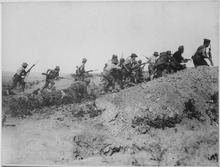

The British and French opened overseas fronts with theÂ
Gallipoli (1915) andÂ
Mesopotamian campaigns (1914). In Gallipoli, the Ottoman Empire successfully repelled the British, French, andÂ
Australian and New Zealand Army Corps (ANZACs). InÂ
Mesopotamia, by contrast, after the defeat of the British defenders in theÂ
Siege of Kut by the Ottomans (1915–16), British Imperial forces reorganised and capturedÂ
Baghdad in March 1917. The British were aided in Mesopotamia by local Arab and Assyrian tribesmen, while the Ottomans employed local Kurdish and Turcoman tribes.

Further to the west, the Suez Canal was defended from Ottoman attacks in 1915 and 1916; in August, a German and Ottoman force was defeated at theÂ
Battle of Romani by theÂ
ANZAC Mounted Division and theÂ
52nd (Lowland) Infantry Division. Following this victory, anÂ
Egyptian Expeditionary Force advanced across theÂ
Sinai Peninsula, pushing Ottoman forces back in theÂ
Battle of Magdhaba in December and theÂ
Battle of Rafa on the border between the EgyptianÂ
Sinai and Ottoman Palestine in January 1917.


Russian armies generally had success in the Caucasus.Â
Enver Pasha, supreme commander of the Ottoman armed forces, was ambitious and dreamed of re-conquering central Asia and areas that had been lost to Russia previously. He was, however, a poor commander.
 He launched an offensive against the Russians in the Caucasus in December 1914 with 100,000 troops, insisting on a frontal attack against mountainous Russian positions in winter. He lost 86% of his force at theÂ
Battle of Sarikamish.
The Ottoman Empire, with German support, invadedÂ
Persia (modernÂ
Iran) in December 1914 in an effort to cut off British and Russian access toÂ
petroleum reservoirs aroundÂ
Baku near theÂ
Caspian Sea.


Persia, ostensibly neutral, had long been under the spheres of British and Russian influence. The Ottomans and Germans were aided byÂ
Kurdish andÂ
Azeri forces, together with a large number of major Iranian tribes, such as theÂ
Qashqai,Â
Tangistanis,Â
Luristanis, andÂ
Khamseh, while the Russians and British had the support of Armenian and Assyrian forces. TheÂ
Persian Campaign was to last until 1918 and end in failure for the Ottomans and their allies. However, the Russian withdrawal from the war in 1917 led to Armenian and Assyrian forces, who had hitherto inflicted a series of defeats upon the forces of the Ottomans and their allies, being cut off from supply lines, outnumbered, outgunned and isolated, forcing them to fight and flee towards British lines in northern Mesopotamia.


GeneralÂ
Yudenich, the Russian commander from 1915 to 1916, drove the Turks out of most of the southern Caucasus with a string of victories.


In 1917, RussianÂ
Grand Duke Nicholas assumed command of the Caucasus front. Nicholas planned a railway fromÂ
Russian Georgia to the conquered territories, so that fresh supplies could be brought up for a new offensive in 1917. However, in March 1917 (February in the pre-revolutionary Russian calendar), the Tsar abdicated in the course of theÂ
February Revolution, and theÂ
Russian Caucasus Army began to fall apart.TheÂ
Arab Revolt, instigated by the Arab bureau of the BritishÂ
Foreign Office, started June 1916 with theÂ
Battle of Mecca, led byÂ
Sherif Hussein ofÂ
Mecca, and ended with the Ottoman surrender of Damascus.Â
Fakhri Pasha, the Ottoman commander ofÂ
Medina, resisted for more than two and half years during theÂ
Siege of Medina before surrendering in January 1919.


heÂ
Senussi tribe, along the border of Italian Libya and British Egypt, incited and armed by the Turks, waged a small-scale guerrilla war against Allied troops. The British were forced to dispatch 12,000 troops to oppose them in theÂ
Senussi Campaign. Their rebellion was finally crushed in mid-1916.


otal Allied casualties on the Ottoman fronts amounted 650,000 men. Total Ottoman casualties were 725,000 (325,000 dead and 400,000 wounded).

 Newspaper from Greece


 Facebook
 Instagram
 Discord
 Reddit