
Cod Wars | Tweet
Published in Greece  - Warfare analysis - 1 - 05 Sep 20 02:57
The Cod Wars (Icelandic: ÞorskastrÃðin, the cod wars, or LandhelgisstrÃðin, the wars for the territorial waters) were a series of confrontations between the United Kingdom and Iceland on fishing rights in the North Atlantic. Each of the disputes ended with an Icelandic victory. The Third Cod War concluded in 1976, with a highly favourable agreement for Iceland; the United Kingdom conceded to a 200-nautical-mile (370-kilometre) Icelandic exclusive fishery zone after threats that Iceland would withdraw from NATO, which would have forfeited NATOs access to most of the GIUK gap, a critical anti-submarine warfare chokepoint during the Cold War.As a result, British fishing communities lost access to rich areas and were devastated, with thousands of jobs lost. Since 1982, a 200-nautical-mile (370-kilometre) exclusive economic zone has been the United Nations standard.The term cod war was coined by a British journalist in early September 1958. one of the Cod Wars met any of the common thresholds for a conventional war, and they may more accurately be described as militarised interstate disputes. There is only one confirmed death during the Cod Wars: an Icelandic engineer, who was accidentally killed in the Second Cod War while he was repairing damage on the Icelandic patrol boat Ægir after a collision with the British frigate Apollo. They collided on 29 August 1973. A trawlerman from Grimsby was wounded on 19 February 1976, hit by the loose cordage after an Icelandic gunboat cut his vessels net. Several explanations for the Cod Wars have been put forward. Recent studies have focused on the underlying economic, legal and strategic drivers for Iceland and the United Kingdom, as well as the domestic and international factors that contributed to the escalation of the dispute. Lessons drawn from the Cod Wars have been applied to international relations theory.
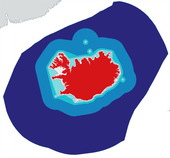 
Expansion of the Icelandic exclusive economic zone (EEZ).  Iceland  Internal waters  4 nmi expansion 1952  12 nmi expansion (current extent of territorial waters) 1958  50 nmi expansion 1972  200 nmi expansion (current extent of EEZ) 1975
Background
Until 1949
Fishermen from Britain began to fish in the international waters near Iceland in the 15th century. From the early 16th century onward, English sailors and fishermen were a major presence in the waters off Iceland. Some Icelandic historians view the history of Icelands struggle for control of its maritime resources in ten episodes, or ten cod wars. The first episode was a dispute between Norway and England in 1415 to 1425 over Englands trading with Iceland in violation of Norways monopoly on the Icelandic trade. The dispute ended when the English arrested Eric of Pomeranias officials in Iceland, effectively restoring the Anglo-Icelandic trade. The agreement that was reached in 1976 concluded what in modern times is called the Third Cod War (the final and tenth Cod War in long-term history).
With the increases in range of fishing that were enabled by steam power in the late 19th century, boat owners and skippers felt pressure to exploit new grounds. Their large catches in Icelandic waters attracted more regular voyages across the North Atlantic. In 1893, the Danish government, which then governed Iceland and the Faroe Islands, claimed a fishing limit of 50 nmi (93 km) around their shores. British trawler owners disputed the claim and continued to send their ships to the waters near Iceland. The British government did not recognise the Danish claim on the grounds that setting such a precedent would lead to similar claims by the nations around the North Sea, which would damage the British fishing industry.
In 1896, the United Kingdom made an agreement with Denmark for British vessels to use any Icelandic port for shelter if they stowed their gear and trawl nets. In return, British vessels were not to fish in Faxa Bay east of a line from Ãlunýpa, a promontory near KeflavÃk to Þormóðssker (43.43° N, 22.30° W).
With many British trawlers being charged and fined by Danish gunboats for fishing illegally within the 13 nmi (24 km) limit, which the British government refused to recognise, the British press began to enquire why the Danish action against British interests was allowed to continue without intervention by the Royal Navy. The British made a show of naval force (gunboat diplomacy) in 1896 and 1897.
In April 1899, the steam trawler Caspian was fishing off the Faroe Islands when a Danish gunboat tried to arrest her for allegedly fishing illegally inside the limits. The trawler refused to stop and was fired upon first with blank shells and then with live ammunition. Eventually, the trawler was caught, but before the skipper, Charles Henry Johnson, left his ship to go aboard the Danish gunboat, he ordered the mate to make a dash for it after he went on to the Danish ship. The Caspian set off at full speed. The gunboat fired several shots at the unarmed boat but could not catch up with the trawler, which returned, heavily damaged, to Grimsby, England. On board the Danish gunboat, the skipper of the Caspian was lashed to the mast. A court held at Thorshavn convicted him on several counts including illegal fishing and attempted assault, and he was jailed for 30 days
The Anglo-Danish Territorial Waters Agreement of 1901, which set 3Â nmi (6Â km) territorial limits, measured narrowly, for Iceland for 50 years.
The Icelandic fisheries grew in importance for the British fishing industry around the end of the 19th century. he reduction in fishing activity brought about by the hostilities of the First World War effectively ended the dispute for a time.
While data is incomplete for the prewar period, one historian argues that the Icelandic fishing grounds were very important to the British fishing industry as a whole. Data from 1919 to 1938 showed a significant increase in the British total catches in Icelandic waters. The British catches in Iceland were more than twice the combined catches of all other grounds of the British distant water fleet. Icelanders grew increasingly dismayed at the British presence.
Support
MarkuintsiggerComments (1)

 Facebook
 Instagram
 Discord
 Reddit