
 Newspaper from Albania
League of Lezhë | Tweet
Published in United States of America  - Social interactions and entertainment - 0 - 01 Nov 20 13:36
The League of Lezhë (Albanian: Lidhja e Lezhës) was a military alliance of Albanian feudal lords forged in Lezhë on 2 March 1444, with Skanderbeg as leader of the regional Albanian and Serbian chieftains united against the Ottoman Empire. Skanderbeg was proclaimed Chief of the League of the Albanian people.League of LezhëActiveArea of operationsSizeAlliesOpponent(s)Battles and war(s)The main members of the league were the Arianiti, Balšić, Zaharia, Muzaka, Spani, Thopia and Crnojevići. The members contributed to the League with men and money, while Skanderbeg had no right to interfere with the affairs of their domains. All earlier and many modern historians accepted Marin Barletis news about this meeting in Lezhë (without giving it equal weight), although no contemporary Venetian document mentions it. Barleti referred to the meeting as the generalis concilium or universum concilium (general council or whole council); the term League of Lezhë was coined by subsequent historians. BackgroundEdit Skanderbeg, leader of the League of LezhëAfter the death of Serbian Emperor Stefan Dušan in 1355, the magnates in Albania established their own dominions. When Ottoman forces entered Albania, they were faced with small principalities that were engaged in vicious fights among themselves. The first battle against the Ottoman forces in Albania was that of Balša II, the Lord of Zeta, when one of the Albanian rulers, Karlo Thopia, invited Ottomans who defeated and killed Balša II in the battle of Savra which happened on 18 September 1385.In the 15th century, the Ottoman Empire established itself in the Balkans with no significant resistance offered by local Christian nobles. Many of them were still fighting amongst themselves and didnt see the Ottoman advance as a threat to their power. Although a civil war broke out between Bayezid Is sons in 1402–13, none of the Christian noblemen in the Balkans at the time seized the opportunity to repel the Ottomans; on the contrary, Bulgarians, Serbs and Hungarians even helped the future Sultan Mehmed I seize power, by participating as his allies in the final battle against his brother. After the Ottoman civil war was over in favour of Mehmed I, his forces captured Kruja from the Thopia in 1415, Berat in 1417 from the Muzaka, Vlora and Kanina in 1417 from the widow of Balša III and Gjirokastër in 1418 from the Zenevisi. Under pressure from the Ottoman Empire and the Republic of Venice, the Albanian principalities began to vacillate. Some Albanian nobility revolted in 1432–36.In November 1443, Skanderbeg captured Kruja with his troops and declared its independence from the Sultan.FormationEdit
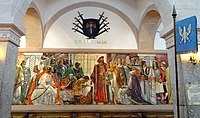 League of Lezhe painting in the Skanderbeg-Museum in KrujeThe League of Lezhë was founded on 2 March 1444 by:
 Albanian assault on an Ottoman encampmentBy 1468, the 10,000-strong Skanderbeg army could withstand the Ottomans. The Albanians received financial support from Venice and from the kings of Hungary and Naples. After Skanderbeg died in 1468, the Lezha League began to disintegrate. Following the Venetians, the Northern Albanians in particular continued the fight against the Ottomans. When the Shkodra, which until then had been dominated by the Venetians, was taken by the Ottomans in 1479, the resistance collapsed and the entire Albanian settlement area was incorporated into the Ottoman Empire.There was also a short-war between Albania and Venice in 1447-1448 but on 4 October 1448, the Albanian–Venetian War ended when Skanderbeg and Nicholas Dukagjini signed a peace treaty with Venice, which would keep its possessions in Albania, including Dagnum, under the conditions that Venice pay a yearly sum of 1,400 ducats, and that some league members would benefit from certain trade privileges, etc.Dissolution and aftermathEdit
 Veroneses Siege of Shkodër in 1478The alliance was precarious. Though an official date of dissolution is unknown, the League of Lezhë fragmented soon after its founding, with many of its members breaking away. By 1450 it had certainly ceased to function as originally intended, and only the core of the alliance under Skanderbeg and Arianiti continued to fight against the Ottomans. Some members preferred to act in line with their own interests. During the attack of the sultan in 1450, they kept changing their position between supporting the Ottomans and joining Skanderbeg. After Peter Spani and George Dushmani left the alliance, and after the Arianiti and Dukagjini left it in 1450, members of Dukagjini family concluded peace with the Ottoman Empire and even began to plot against Skanderbeg.Skanderbeg commandersEdit
 Skanderbeg, leader of the League of LezhëAfter the death of Serbian Emperor Stefan Dušan in 1355, the magnates in Albania established their own dominions. When Ottoman forces entered Albania, they were faced with small principalities that were engaged in vicious fights among themselves. The first battle against the Ottoman forces in Albania was that of Balša II, the Lord of Zeta, when one of the Albanian rulers, Karlo Thopia, invited Ottomans who defeated and killed Balša II in the battle of Savra which happened on 18 September 1385.In the 15th century, the Ottoman Empire established itself in the Balkans with no significant resistance offered by local Christian nobles. Many of them were still fighting amongst themselves and didnt see the Ottoman advance as a threat to their power. Although a civil war broke out between Bayezid Is sons in 1402–13, none of the Christian noblemen in the Balkans at the time seized the opportunity to repel the Ottomans; on the contrary, Bulgarians, Serbs and Hungarians even helped the future Sultan Mehmed I seize power, by participating as his allies in the final battle against his brother. After the Ottoman civil war was over in favour of Mehmed I, his forces captured Kruja from the Thopia in 1415, Berat in 1417 from the Muzaka, Vlora and Kanina in 1417 from the widow of Balša III and Gjirokastër in 1418 from the Zenevisi. Under pressure from the Ottoman Empire and the Republic of Venice, the Albanian principalities began to vacillate. Some Albanian nobility revolted in 1432–36.In November 1443, Skanderbeg captured Kruja with his troops and declared its independence from the Sultan.FormationEdit
 League of Lezhe painting in the Skanderbeg-Museum in KrujeThe League of Lezhë was founded on 2 March 1444 by:
- Lekë Zaharia (lord of Sati and Dagnum), and his vassals Pal and Nicholas DukagjiniPeter Spani (lord of the mountains behind Drivasto)Lekë Dushmani (lord of Minor Pult)George Strez, John and Gojko Balšić (lords of Misia, between Kruja and Alessio)Andrea Thopia (lord of Scuria, between Tirana and Durazzo) with his nephew TanushGjergj ArianitiTheodor Corona MusachiStefan Crnojević (lord of Upper Zeta)
 Albanian assault on an Ottoman encampmentBy 1468, the 10,000-strong Skanderbeg army could withstand the Ottomans. The Albanians received financial support from Venice and from the kings of Hungary and Naples. After Skanderbeg died in 1468, the Lezha League began to disintegrate. Following the Venetians, the Northern Albanians in particular continued the fight against the Ottomans. When the Shkodra, which until then had been dominated by the Venetians, was taken by the Ottomans in 1479, the resistance collapsed and the entire Albanian settlement area was incorporated into the Ottoman Empire.There was also a short-war between Albania and Venice in 1447-1448 but on 4 October 1448, the Albanian–Venetian War ended when Skanderbeg and Nicholas Dukagjini signed a peace treaty with Venice, which would keep its possessions in Albania, including Dagnum, under the conditions that Venice pay a yearly sum of 1,400 ducats, and that some league members would benefit from certain trade privileges, etc.Dissolution and aftermathEdit
 Veroneses Siege of Shkodër in 1478The alliance was precarious. Though an official date of dissolution is unknown, the League of Lezhë fragmented soon after its founding, with many of its members breaking away. By 1450 it had certainly ceased to function as originally intended, and only the core of the alliance under Skanderbeg and Arianiti continued to fight against the Ottomans. Some members preferred to act in line with their own interests. During the attack of the sultan in 1450, they kept changing their position between supporting the Ottomans and joining Skanderbeg. After Peter Spani and George Dushmani left the alliance, and after the Arianiti and Dukagjini left it in 1450, members of Dukagjini family concluded peace with the Ottoman Empire and even began to plot against Skanderbeg.Skanderbeg commandersEdit
- Gjergj ArianitiNicholas Dukagjini , passed to the Ottomans in 1457Pal III Dukagjini , passed to the Ottomans in 1457Moisi Arianit Golemi , passed to the Ottomans in 1457Hamza Kastrioti , Skanderbegs nephew, passed to the Ottomans in 1457Vladan Jurica, General Quartermaster SkanderbegsVrana KontiPeter PerlataiMarin SpaniAndrea ThopiaKarl Muzak ThopiaTanush Thopia
Support
Unknown18DoethBlaiddDoethBlaiddDoethBlaiddSHKABASHKABASHKABAArb3rMandisaMandisaComments (0)
 Facebook
 Instagram
 Discord
 Reddit