
The best movie from Yugoslavia ( Must see ) | Tweet
Published in Serbia  - Social interactions and entertainment - 5 - 10 Dec 20 02:36
1. I Even Met Happy Gypsies (Skupljaci perja) 1967
Director: Dušan Makavejev
Stars: Bekim Fehmiu, Olivera Katarina, Velimir Bata Živojinović
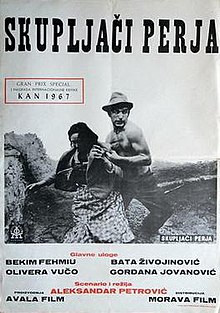
Almost 50 years since its release, and I Even Met Happy Gypsies, still rumbles with immediacy and energy. It is initially a very confusing film, dropping the viewer right into a world of Roma interfighting and shady business dealings on the muddy, ugly and unending plains of Vojvodina, the agricultural heartland of Yugoslavia in northern Serbia.
The characters introduced are sometimes hard to follow, and director Aleksander Petrović, a leading light of the Black Wave, refuses to explain the story to us, instead preferring to capture events unfold with an almost documentary realism.
The shock of the film may be lost on viewers today – such a purposely ugly film went completely against the grain of Communist propaganda which tended to portray Yugoslavia as a shining happy place full of happy Yugoslavs – but the film’s depictions of the underclass, the poverty-stricken bare bones existence of the Roma people still has value today, in a world which seems increasingly content to stamp out the voice of the downtrodden.
I Even Met Happy Gyspies has no happy Gypsies in it, just a collection of poor, depressed people, doing their best to survive and being exploited by criminals and mafiosos from within their own groups.
2. Who’s That Singing Over There? (Ko to tamo peva) 1980
Director:Â Slobodan Sijan
Stars: Pavle Vuisic, Dragan Nikolic, Danilo Bata Stojkovic
Who’s That Singing Over There? is widely regarded as one of the greatest comedies in Yugoslavia, as well as one of the most subversive and intelligent. Scripted by Dušan Kovacević and directed by Slobodan Šijan (the duo followed up the success of this film with the equally famed and successful The Marathon Family), Who’s That Singing Over There follows a group of mismatched travellers journeying on a bus to Belgrade on the eve of the Second World War.
The cast of characters are broad, but each one represents a particular aspect of Yugoslav life. The young couple from the village (Slavko Štimac and Neda Arnerić), the latter keen to see life and the world outside of her house, the former a bit hapless and naive, an awkward lover and more interested in stuffing himself than in his wife’s happiness.
The smug, charming singer (Dragan Nikolić at his smarmiest) who is convinced of his abilities to seduce any woman. The bureaucratic busybody (Danilo Stojković), who moans about Yugoslav inefficiency and openly welcomes the forthcoming German invasion, hoping it will bring law and order to a chaotic land. The hapless, accident-prone hunter (TaÅ¡ko NaÄić) who gets kicked off the bus and somehow manages to keep pace with it on foot.
Towering above them all is the bus conductor (Pavle Vujisić), an authority figure so inept and inconsistent it’s a miracle the bus gets anywhere at all. Kovacević, a famed Serbian playwright before moving into filmmaking has produced many fine comedies, but have been as sharp, pointed, and gloriously ironic as this one. A deserved classic.
 
3. Balkan Spy (Balkanski špijun) 1984
Director: Dusan Kovacevic, Bozidar Bota Nikolic
Stars: Danilo Bata Stojkovic, Bora Todorovic, Mira Banjac
Even in a comparitively liberal communist state, surveillance by secret police was still a daily occurrence for most Yugoslavs. Although the UDBA would never acheive the notoriety of some of its fellow organisations like the Stasi, it was still a dangerous toy to play with for any potentially dissident civilian. Enter Balkan Spy, directed Bota Nikolić and Dušan Kovacević in his first directorial role, a hilarious spoof of the paranoia inculculated by state security.
A former dissident, Ilija (Danilo Stojković) becomes fearful that his new tenant, Petar (Bora Todorovic), just back from Paris with plans to open a tailor shop in Belgrade, is actually a foreign spy, and sets about conducting his own spying operations on the man so as not to fall afoul of the UDBA should his tenant be caught conspiring.
Satirising and poking great fun at secret police tactics as well the paranoia inculculated by communism, Balkan Spy was a great success at the time of its release, and is still relevant today; recent research has suggested that freedom of speech and media in the Balkans today is even lower than it was in the mid-90s when the war was at its peak, and the current government in Serbia led by Aleksander Vucić for example, is not above sending thugs to break up opposition meetings.
The film’s enduring appeal is also helped by Stojković’s, one of Yugoslavia’s most recognisable actors, whose small pudgy stature and paternalistic eyes made him ideal for playing fussy, pedantic bores who would tire other people out with their neuroses and finickiness.

4. The Marathon Family (Maratonci trÄe poÄasni krug) 1982
Director: Slobodan Å ijan
Stars: Bogdan Diklić, Danilo Bata Stojković, Pavle Vujisić, Zoran Radmilović
The story takes place in an unnamed small Serbian town in 1935, and focuses on the Topalović family consisting of six generations of undertakers: gravely ill Pantelija, wheelchair-bound Maksimilijan whos also mute and nearly deaf, rheumatic Aksentije, sober-minded Milutin, impulsive and narcissistic Laki, and young and naive Mirko. Constantly bickering amongst each other, the latest family arguments arise from the youngest son, Mirko, not wanting to continue the family business of coffin-making. Deeply in love with a local girl Kristina, the daughter of a local hoodlum Bili Piton, hes looking to avoid the career path of his father, grandfather, great grandfather, etc.
Though operating out of a prominently located shop in the town, Topalovićs business is mostly based on illegal activities. Instead of making brand new coffins, they simply recycle already used ones with the help of Bili Piton, whose men dig them out from the local cemetery during the night. Once they get their hands on the coffins that had been dug up, Topalovićs simply refurbish them and sell them as new, thereby making a large profit with very little overhead. Based on mutual financial interest, the business relationship between Topalovićs and Bili is deteriorating by the day as they owe him a large sum of money for the past services rendered and show no intention of paying him.
In parallel, Topalovićs are in the finishing stages of building a modern crematory on which theyre placing high hopes as the future source of income.
 
5. Balkan Express (Balkan Ekspres) 1983
Director: Branko Baletić
Stars: Dragan Nikolić, Bora Todorović, Tanja Bošković
An endearing wartime adventure film about a group of low-rent thieves and conmen who find themselves caught up in the middle of the Nazi invasion of Yugoslavia, struggling to decide whether to fight or to fly. They don’t really ‘choose’ in the end, becoming heroes by accident rather than design.
Directed by Branko Baletić, Balkan Express features an array of excellent comedic performances from a superb Yugo-cast. Dragan Nikolić, here at the pinnacle of his dashing, rapscallion star-power leads the way, but he’s ably supported by Bora Todorović and Tanja Bošović.
Set mostly in the undulating plains and endless vistas of northern Yugoslavia, Balkan Express centres itself around some recurring themes of Yugoslav cinema – its lovable rogues becoming heroes of the resistance more by accident rather than pure communist ideological fervour would be repeated in Emir Kusturica’s Underground, and its willingness to poke fun at even the darkest aspects of Yugoslavian history is a recurring happenstance across many Yugoslav films; the biggest laugh in Balkan Express coming in its most downbeat, depressing scene.
Â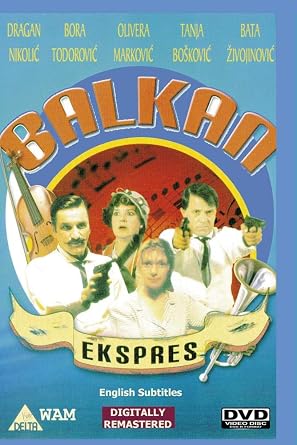 
6.  When Father Was Away on Business (Otac na službenom putu) 1985
Director:Â Emir Kusturica
Stars: Moreno DE Bartolli, Predrag Miki Manojlović, Mirjana Karanović, Mustafa Nadarević
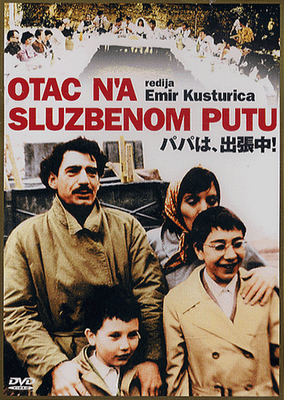
The first of two Palme D’or winners for Emir Kusturica came in 1985 with When Father Was Away on Business. Kusturica’s early career was marked by a series of fantastic coming-of-age films that combined the best of the bittersweet comic ironies featured in the films of the Black Wave with the cinematic grace and fluidity of the big-hitting European giants of arthouse cinemas at the time – Fellini, Bergman, Tarkovsky and the like.
Amidst the Tito-Stalin split in 1948 and the heightened political tensions amongst loyal Communists (“I’d rather eat Russian shit than American cake†one character shouts), Malik’s father Meša (Miki Manojlović) complains gently about the mood of anti-Stalinism. Unfortunately, his brother-in-law, a loyal bureaucrat, has a bone to pick with Meša, and upon hearing of this transgression sends him to prison.
This sends the family on a trip through Yugoslavia, moving from place to place trying to escape the shadow of ideological repression – at one point the boy makes friends with a Russian émigré girl (whose family have likely suffered the same repression purely by virtue of their origin) in the film’s most sweetest, most heartbreaking sequence.
Sprinkled with the influence of magical realism, on what was only his second feature film Kusturica crafts perhaps the greatest single film in Yugoslav history, a film bursting with life, energy, emotions on all ends of the spectrum. One of the greatest films of our times.
7. Underground (Podzemlje) 1995
Director: Emir Kusturica
Stars: Predrag Miki Manojlović, Lazar Ristovski, Mirjana Joković
Underground was Kusturica’s second Palme D’or winner at Cannes, and is also his most controversial; at one point the debate that raged around the film frustrated Kusturica so much he claimed he would retire from filmmaking, although he went back on that promise. The mixture of allegory and metaphor in Underground is enough to fill an entire book, so to do it justice in just a few paragraphs is not easy. Over the course of the film’s near three-hour running time and 40-year narrative span it rarely lets up its unique artistic focus.
Starting in World War II, we meet two friends, Blacky (Lazar Ristovski) and Marko (Miki Manojlović), who both enrol in the Communist party and deal in black market trading. Amidst the chaos of the war, Blacky also finds time for a mistress, Natalija (Mirjana Joković), whose attentions he competes for with a German officer, going so far as to interrupt a theatrical performance she stars in to shoot the German and run away.
When Blacky is injured, he is sent to Marko’s underground cellar, with a host of other wartime refugees. However, with the end of the war Marko doesn’t open the cellar, instead telling its denizens that the war above ground is still raging and having them produce firearms for him, even going so far as to fake German bombings raids.
Meanwhile, above ground Marko becomes an important Communist dignitary and poet, praising Blacky’s exploits and turning him into a martyr for the Partisan cause, even marrying Natalija eventually. One day, amidst a drunken wedding the inhabitants escape their prison, and find a world that has changed unimaginably since they were sealed in.
 
8. Pretty Village Pretty Flames (Lepa Sela Lepo Gore) 1996
Director: Srdjan DragojevićÂ
Stars: Dragan Bjelogrlic, Nikola Kojo, Dragan Maksimović
Director/writer Srdjan Dragojević employs a complex flashback structure that allows him to flit between the childhood life of Milan (Dragan Bjelogrlić) and Halil (Nikola Pejakovć), a Serb and a Muslim who were best friends in peaceful times; Milan’s time in the Bosnian war, stuck in a tunnel under siege by his former friend; and his recuperation in a hospital with fellow surviving soldiers.
The group of soldiers stuck in that tunnel, able to hear the enemy but not see him (a wonderful device that demonstrates precisely how nationalist hatred often works), represent a near-perfect cross-section of the varying groups of Serbs caught up in the Bosnian war.
Some of them are willing, such as the old Yugoslav army captain Gvozden (Bata Zivojinović, a piece of clever casting as he was famed in the 60s and 70s for starring in many of the Partisan war films as a gung-ho action star), who still lives enamoured in the shadow of Titoism and believes he’s fighting for Yugoslavia; there is also ViljuÅ¡ka (Milorad Mandić), a Serbian ultranationalist ÄŒetnik who spews over-the-top maxims like “did you know the Serbs are the world’s oldest people?!â€
Others are unwilling; Milan appears to have been forced into the war simply because it’s happening on his home turf, and a professor and a drug junkie have also been coned into the battle, taken from their homes, given guns, and told to fight. What results is a depressing, angry, brutal film that depicts the heavy effects of nationalism on the psychology of those forced to fight for it.
 
9. Barking at the Stars (Lajanje na zvezde) 1998
Director: Zdravko Å otra
Stars: Dragan Mićanović, Nataša Tapusković ex Šolak, Nikola Simić
In the most difficult period in this region, probably the most beautiful movie of domestic cinematography was filmed. This is a story about one amazing school class with a lot of spirit and energy characteristic of youth, about first sympathies and some old, nice times when the students respected the elderly, and so did the professors, building a relationship with them. The director Zdravko Šotra, during the creation of Barking at the stars, took care to show humor without swearing, so you can not hear a single swear in the movie. Dragan Micanovic, Bogdan Diklic, Natasa Tapusković, Nikola Simic, Vesna Trivalic, Dragan Jovanovic, Nikola Djuricko, Velimir Bata Zivojinovic and Branimir Brstina are just some of the names that appear in the roles of silly students and teachers. This film will remind you of the most beautiful school times with adventures in which endlessly entertaining characters try to learn the beauty of love and eternal friendship. You can’t see severe scenes or violence here, and that is why this comedy is considered as a must-watch for all future generations.
 
10. We Are Not Angels (Mi nismo Andjeli) 1992
Director: Srdjan Dragojević
Stairs: Nikola Kojo, Milena Pavlović, Branka Katić
We Are Not Angels  is a 1992 Serbian comedy movie, directed by SrÄ‘an Dragojević that became one of the most popular films of the 1990s in the region of the former Yugoslavia. The plot revolves around Angel (played by UroÅ¡ Äurić) and Devil (SrÄ‘an Todorović) fighting for the soul of Belgrade playboy Nikola (Nikola Kojo) who is unaware that he impregnated a high school student named Marina (Milena Pavlović) during a drunken one-night stand.

      
Director: Dušan Makavejev
Stars: Bekim Fehmiu, Olivera Katarina, Velimir Bata Živojinović
Almost 50 years since its release, and I Even Met Happy Gypsies, still rumbles with immediacy and energy. It is initially a very confusing film, dropping the viewer right into a world of Roma interfighting and shady business dealings on the muddy, ugly and unending plains of Vojvodina, the agricultural heartland of Yugoslavia in northern Serbia.
The characters introduced are sometimes hard to follow, and director Aleksander Petrović, a leading light of the Black Wave, refuses to explain the story to us, instead preferring to capture events unfold with an almost documentary realism.
The shock of the film may be lost on viewers today – such a purposely ugly film went completely against the grain of Communist propaganda which tended to portray Yugoslavia as a shining happy place full of happy Yugoslavs – but the film’s depictions of the underclass, the poverty-stricken bare bones existence of the Roma people still has value today, in a world which seems increasingly content to stamp out the voice of the downtrodden.
I Even Met Happy Gyspies has no happy Gypsies in it, just a collection of poor, depressed people, doing their best to survive and being exploited by criminals and mafiosos from within their own groups.
2. Who’s That Singing Over There? (Ko to tamo peva) 1980
Director:Â Slobodan Sijan
Stars: Pavle Vuisic, Dragan Nikolic, Danilo Bata Stojkovic
Who’s That Singing Over There? is widely regarded as one of the greatest comedies in Yugoslavia, as well as one of the most subversive and intelligent. Scripted by Dušan Kovacević and directed by Slobodan Šijan (the duo followed up the success of this film with the equally famed and successful The Marathon Family), Who’s That Singing Over There follows a group of mismatched travellers journeying on a bus to Belgrade on the eve of the Second World War.
The cast of characters are broad, but each one represents a particular aspect of Yugoslav life. The young couple from the village (Slavko Štimac and Neda Arnerić), the latter keen to see life and the world outside of her house, the former a bit hapless and naive, an awkward lover and more interested in stuffing himself than in his wife’s happiness.
The smug, charming singer (Dragan Nikolić at his smarmiest) who is convinced of his abilities to seduce any woman. The bureaucratic busybody (Danilo Stojković), who moans about Yugoslav inefficiency and openly welcomes the forthcoming German invasion, hoping it will bring law and order to a chaotic land. The hapless, accident-prone hunter (TaÅ¡ko NaÄić) who gets kicked off the bus and somehow manages to keep pace with it on foot.
Towering above them all is the bus conductor (Pavle Vujisić), an authority figure so inept and inconsistent it’s a miracle the bus gets anywhere at all. Kovacević, a famed Serbian playwright before moving into filmmaking has produced many fine comedies, but have been as sharp, pointed, and gloriously ironic as this one. A deserved classic.
3. Balkan Spy (Balkanski špijun) 1984
Director: Dusan Kovacevic, Bozidar Bota Nikolic
Stars: Danilo Bata Stojkovic, Bora Todorovic, Mira Banjac
Even in a comparitively liberal communist state, surveillance by secret police was still a daily occurrence for most Yugoslavs. Although the UDBA would never acheive the notoriety of some of its fellow organisations like the Stasi, it was still a dangerous toy to play with for any potentially dissident civilian. Enter Balkan Spy, directed Bota Nikolić and Dušan Kovacević in his first directorial role, a hilarious spoof of the paranoia inculculated by state security.
A former dissident, Ilija (Danilo Stojković) becomes fearful that his new tenant, Petar (Bora Todorovic), just back from Paris with plans to open a tailor shop in Belgrade, is actually a foreign spy, and sets about conducting his own spying operations on the man so as not to fall afoul of the UDBA should his tenant be caught conspiring.
Satirising and poking great fun at secret police tactics as well the paranoia inculculated by communism, Balkan Spy was a great success at the time of its release, and is still relevant today; recent research has suggested that freedom of speech and media in the Balkans today is even lower than it was in the mid-90s when the war was at its peak, and the current government in Serbia led by Aleksander Vucić for example, is not above sending thugs to break up opposition meetings.
The film’s enduring appeal is also helped by Stojković’s, one of Yugoslavia’s most recognisable actors, whose small pudgy stature and paternalistic eyes made him ideal for playing fussy, pedantic bores who would tire other people out with their neuroses and finickiness.
4. The Marathon Family (Maratonci trÄe poÄasni krug) 1982
Director: Slobodan Å ijan
Stars: Bogdan Diklić, Danilo Bata Stojković, Pavle Vujisić, Zoran Radmilović
The story takes place in an unnamed small Serbian town in 1935, and focuses on the Topalović family consisting of six generations of undertakers: gravely ill Pantelija, wheelchair-bound Maksimilijan whos also mute and nearly deaf, rheumatic Aksentije, sober-minded Milutin, impulsive and narcissistic Laki, and young and naive Mirko. Constantly bickering amongst each other, the latest family arguments arise from the youngest son, Mirko, not wanting to continue the family business of coffin-making. Deeply in love with a local girl Kristina, the daughter of a local hoodlum Bili Piton, hes looking to avoid the career path of his father, grandfather, great grandfather, etc.
Though operating out of a prominently located shop in the town, Topalovićs business is mostly based on illegal activities. Instead of making brand new coffins, they simply recycle already used ones with the help of Bili Piton, whose men dig them out from the local cemetery during the night. Once they get their hands on the coffins that had been dug up, Topalovićs simply refurbish them and sell them as new, thereby making a large profit with very little overhead. Based on mutual financial interest, the business relationship between Topalovićs and Bili is deteriorating by the day as they owe him a large sum of money for the past services rendered and show no intention of paying him.
In parallel, Topalovićs are in the finishing stages of building a modern crematory on which theyre placing high hopes as the future source of income.
5. Balkan Express (Balkan Ekspres) 1983
Director: Branko Baletić
Stars: Dragan Nikolić, Bora Todorović, Tanja Bošković
An endearing wartime adventure film about a group of low-rent thieves and conmen who find themselves caught up in the middle of the Nazi invasion of Yugoslavia, struggling to decide whether to fight or to fly. They don’t really ‘choose’ in the end, becoming heroes by accident rather than design.
Directed by Branko Baletić, Balkan Express features an array of excellent comedic performances from a superb Yugo-cast. Dragan Nikolić, here at the pinnacle of his dashing, rapscallion star-power leads the way, but he’s ably supported by Bora Todorović and Tanja Bošović.
Set mostly in the undulating plains and endless vistas of northern Yugoslavia, Balkan Express centres itself around some recurring themes of Yugoslav cinema – its lovable rogues becoming heroes of the resistance more by accident rather than pure communist ideological fervour would be repeated in Emir Kusturica’s Underground, and its willingness to poke fun at even the darkest aspects of Yugoslavian history is a recurring happenstance across many Yugoslav films; the biggest laugh in Balkan Express coming in its most downbeat, depressing scene.
Â
6.  When Father Was Away on Business (Otac na službenom putu) 1985
Director:Â Emir Kusturica
Stars: Moreno DE Bartolli, Predrag Miki Manojlović, Mirjana Karanović, Mustafa Nadarević
The first of two Palme D’or winners for Emir Kusturica came in 1985 with When Father Was Away on Business. Kusturica’s early career was marked by a series of fantastic coming-of-age films that combined the best of the bittersweet comic ironies featured in the films of the Black Wave with the cinematic grace and fluidity of the big-hitting European giants of arthouse cinemas at the time – Fellini, Bergman, Tarkovsky and the like.
Amidst the Tito-Stalin split in 1948 and the heightened political tensions amongst loyal Communists (“I’d rather eat Russian shit than American cake†one character shouts), Malik’s father Meša (Miki Manojlović) complains gently about the mood of anti-Stalinism. Unfortunately, his brother-in-law, a loyal bureaucrat, has a bone to pick with Meša, and upon hearing of this transgression sends him to prison.
This sends the family on a trip through Yugoslavia, moving from place to place trying to escape the shadow of ideological repression – at one point the boy makes friends with a Russian émigré girl (whose family have likely suffered the same repression purely by virtue of their origin) in the film’s most sweetest, most heartbreaking sequence.
Sprinkled with the influence of magical realism, on what was only his second feature film Kusturica crafts perhaps the greatest single film in Yugoslav history, a film bursting with life, energy, emotions on all ends of the spectrum. One of the greatest films of our times.
7. Underground (Podzemlje) 1995
Director: Emir Kusturica
Stars: Predrag Miki Manojlović, Lazar Ristovski, Mirjana Joković
Underground was Kusturica’s second Palme D’or winner at Cannes, and is also his most controversial; at one point the debate that raged around the film frustrated Kusturica so much he claimed he would retire from filmmaking, although he went back on that promise. The mixture of allegory and metaphor in Underground is enough to fill an entire book, so to do it justice in just a few paragraphs is not easy. Over the course of the film’s near three-hour running time and 40-year narrative span it rarely lets up its unique artistic focus.
Starting in World War II, we meet two friends, Blacky (Lazar Ristovski) and Marko (Miki Manojlović), who both enrol in the Communist party and deal in black market trading. Amidst the chaos of the war, Blacky also finds time for a mistress, Natalija (Mirjana Joković), whose attentions he competes for with a German officer, going so far as to interrupt a theatrical performance she stars in to shoot the German and run away.
When Blacky is injured, he is sent to Marko’s underground cellar, with a host of other wartime refugees. However, with the end of the war Marko doesn’t open the cellar, instead telling its denizens that the war above ground is still raging and having them produce firearms for him, even going so far as to fake German bombings raids.
Meanwhile, above ground Marko becomes an important Communist dignitary and poet, praising Blacky’s exploits and turning him into a martyr for the Partisan cause, even marrying Natalija eventually. One day, amidst a drunken wedding the inhabitants escape their prison, and find a world that has changed unimaginably since they were sealed in.
8. Pretty Village Pretty Flames (Lepa Sela Lepo Gore) 1996
Director: Srdjan DragojevićÂ
Stars: Dragan Bjelogrlic, Nikola Kojo, Dragan Maksimović
Director/writer Srdjan Dragojević employs a complex flashback structure that allows him to flit between the childhood life of Milan (Dragan Bjelogrlić) and Halil (Nikola Pejakovć), a Serb and a Muslim who were best friends in peaceful times; Milan’s time in the Bosnian war, stuck in a tunnel under siege by his former friend; and his recuperation in a hospital with fellow surviving soldiers.
The group of soldiers stuck in that tunnel, able to hear the enemy but not see him (a wonderful device that demonstrates precisely how nationalist hatred often works), represent a near-perfect cross-section of the varying groups of Serbs caught up in the Bosnian war.
Some of them are willing, such as the old Yugoslav army captain Gvozden (Bata Zivojinović, a piece of clever casting as he was famed in the 60s and 70s for starring in many of the Partisan war films as a gung-ho action star), who still lives enamoured in the shadow of Titoism and believes he’s fighting for Yugoslavia; there is also ViljuÅ¡ka (Milorad Mandić), a Serbian ultranationalist ÄŒetnik who spews over-the-top maxims like “did you know the Serbs are the world’s oldest people?!â€
Others are unwilling; Milan appears to have been forced into the war simply because it’s happening on his home turf, and a professor and a drug junkie have also been coned into the battle, taken from their homes, given guns, and told to fight. What results is a depressing, angry, brutal film that depicts the heavy effects of nationalism on the psychology of those forced to fight for it.
9. Barking at the Stars (Lajanje na zvezde) 1998
Director: Zdravko Å otra
Stars: Dragan Mićanović, Nataša Tapusković ex Šolak, Nikola Simić
In the most difficult period in this region, probably the most beautiful movie of domestic cinematography was filmed. This is a story about one amazing school class with a lot of spirit and energy characteristic of youth, about first sympathies and some old, nice times when the students respected the elderly, and so did the professors, building a relationship with them. The director Zdravko Šotra, during the creation of Barking at the stars, took care to show humor without swearing, so you can not hear a single swear in the movie. Dragan Micanovic, Bogdan Diklic, Natasa Tapusković, Nikola Simic, Vesna Trivalic, Dragan Jovanovic, Nikola Djuricko, Velimir Bata Zivojinovic and Branimir Brstina are just some of the names that appear in the roles of silly students and teachers. This film will remind you of the most beautiful school times with adventures in which endlessly entertaining characters try to learn the beauty of love and eternal friendship. You can’t see severe scenes or violence here, and that is why this comedy is considered as a must-watch for all future generations.
10. We Are Not Angels (Mi nismo Andjeli) 1992
Director: Srdjan Dragojević
Stairs: Nikola Kojo, Milena Pavlović, Branka Katić
We Are Not Angels  is a 1992 Serbian comedy movie, directed by SrÄ‘an Dragojević that became one of the most popular films of the 1990s in the region of the former Yugoslavia. The plot revolves around Angel (played by UroÅ¡ Äurić) and Devil (SrÄ‘an Todorović) fighting for the soul of Belgrade playboy Nikola (Nikola Kojo) who is unaware that he impregnated a high school student named Marina (Milena Pavlović) during a drunken one-night stand.
      
Support
Predrag1102UndeadJohn DoeMrGoldKosingasSaferburgaskobirichkaedited_playerSrbijanacVojoJosemouSimo HayhaImperatorDejan94coassssTBPTKOTBPTKOTBPTKOTBPTKOCTEBOCTEBAHNenad030ATEHTATOPOTmulejani novakjani novakartis1904John DoejukaUndeadComments (5)





 Facebook
 Instagram
 Discord
 Reddit