EconomicsFrom Wikipedia, the free encyclopedia
Jump to navigationJump to searchThis article is about the social science. For other uses, seeÂ
Economics (disambiguation).
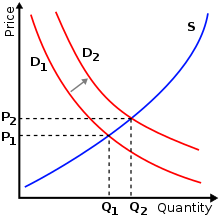 The supply and demand
 model describes how prices vary as a result of a balance between product availability and demand.Economics
Economics (
/É›kəˈnÉ’mɪks, iËkÉ™-/)
 is theÂ
social science that studies how people interact with value; in particular, theÂ
production,Â
distribution, andÂ
consumption ofÂ
goods and services.
Economics focuses on the behaviour and interactions ofÂ
economic agents and howÂ
economies work.Â
Microeconomics analyzes basic elements in the economy, including individual agents andÂ
markets, their interactions, and the outcomes of interactions. Individual agents may include, for example, households, firms, buyers, and sellers.Â
Macroeconomics analyzes the economy as a system where production, consumption, saving, and investment interact, and factors affecting it: employment of the resources of labour, capital, and land, currencyÂ
inflation,Â
economic growth, and public policies that have impact onÂ
these elements.Other broad distinctions within economics include those betweenÂ
positive economics, describing what is, andÂ
normative economics, advocating what ought to be; between economic theory andÂ
applied economics; betweenÂ
rational andÂ
behavioural economics; and betweenÂ
mainstream economics andÂ
heterodox economics.
Economic analysis can be applied throughout society, inÂ
real estate,
Â
business,
Â
finance,Â
health care,
Â
engineering andÂ
government.
 Economic analysis is sometimes also applied to such diverse subjects as crime,Â
education,
 theÂ
family,Â
law,Â
politics,Â
religion,
Â
social institutions,Â
war,
Â
science,
 andÂ
the environment.

 Newspaper from Colombia
 - Social interactions and entertainment - 4 - 05 Mar 21 00:42





 Facebook
 Instagram
 Discord
 Reddit