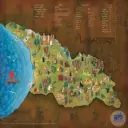
Svaneti | Tweet
Published in Georgia  - Social interactions and entertainment - 2 - 30 Mar 21 11:45
Svaneti,Georgia Live the life of adventures and freedomThere is something majestic about mountains in Svaneti. It can be the tall and grandiose appearance of Shkara or the initial intimidation when you cast your eyes of Ushba and Tetnuldi.In Svaneti you experience absolute freedom, the feeling of achievement and appreciation for the journey in the land of thousand towers.Svanetian cultural identity is based on several main factors:


 General Information about SvanetiOne of the most captivating Georgian regions, Svaneti, is in the northwestern Georgia, along the southern slopes of Greater Caucasus mountains. It consists of two parts – Upper (Zemo) Svaneti and Lower (Kvemo) Svaneti. Four of the 10 highest peaks of the Great Caucasus Range are located in the region, among them the highest picks in Georgia, Shkara (5.200 m) and Janga (5.078m).Svaneti is famous for its original architecture and unique watch towers. In times of danger, lowland Georgians sent icons, jewels, and manus to the mountain churches and towers for safekeeping, turning Svaneti into a repository of early Georgian culture.Mestia, an administrative centre of the region, is gaining more and more popularity. Along with the ancient towers, churches, and historical monuments, it offers up to date facilities, comfortable hotels, bustling city life, delicious food, and warm hospitality.The villages of Ushguli are considered the highest settlement in Europe at the elevation of 2,200 meters above the sea level. This UNESCO World Heritage site is laid out at the foot of Mount Shkhara and offers gorgeous views of snow peak mountains. It is a true masterpiece which captivates travellers, photographers and nature lovers, with its narrow streets, ancient towers, churches, and original houses.Svaneti attracts visitors all year round. In summer, one can enjoy hiking, horseback riding and cycling in the beautiful Caucasus mountains, along with the pristine rivers, turquoise color lakes, and forested trails. In winter, Svaneti is an ideal skiing destination. Towers, covered by the thick layers of dreamy white snow, combined with the high snowcapped mountains, create a stunning wonderland.The Svan language: the language of freedomThe Svan language (Lushnu nin), along with Megrelian, Laz and Georgian, is the outlying member of the Kartvelian (South Caucasian) language family. Georgian is the state language with the original alphabet, considered as one of the most phonemic alphabets in the world. Svan, Megrelian and Laz are only spoken languages. Their writing is based on Georgian alphabet.


 Svan has four dialects and differs from other Kartvelian languages. It preserves some archaisms, that are not present in the other three Kartvelian tongues.Approximately 30,000 people speak Svanuri, mainly in Mestia, Lentekhi districts, and in the settlements along the Enguri river. Some Svan-speaking people live in Abkhazia, the breakaway region of Georgia. Most Svans live in their traditional homeland. Although increasing number of locals move to lowland Georgia, including those displaced by the destruction of Svan villages by avalanches.There is no formal teaching of Svan language. Everyone speaks and uses Georgian on everyday bases. Unfortunately, the number of speakers of Svan language is decreasing day by day.Some useful phrases:Ivasu khari - Thank you
Khocha ladagh – a Svan greeting phrase
Khocha ladegu khar – Good morning
Maguaid khari – How are you
Kochamd – I am wellLocal legends and beliefs: stories of bravery kept in the legendsGeorgia is a country of legends. Original and beautiful stories keep the character and the uniqueness of Georgian regions.Starting from the ancient times, Svans have been collecting the stories and legend of their brave ancestors. They always faced hardships, invasions, natural disasters and death with calmness.By telling the legends and myths, Svan people connect with the nature. The love of their beautiful land has always been stronger than avalanches, attacks from the Northern tribes, and day to day hardships.One of the most famous myths about Georgia is about Argonauts. It tells the Jason’s quest for famous Golden Fleece and is closely related to Svaneti. Famous Greek geographer Strabo referred to modern day Svaneti as the land where gold is carried down by the mountain torrents. According to his studies, people were obtaining it by means of perforated troughs and fleecy skins. This system was quite well known across the world and became the origin of the myth of the golden fleece.Svans are best known as the brave hunters and they believe that during hunting the goddess Dali is always present. According to their legend, Dali lives far away, in the high mountains and is a protector of the wild animals. That is why a hunter who can hunt a wild Caucasian tur is assumed to be a truly gifted one.Since locals believe that Dali is a beautiful woman, there are many love stories connected with her. If the hunter cannot keep the secret of their love, his punishment will be death. In the old Georgian mythology, Amiran, Georgian Prometheus, was a son of Dali and one of the hunters. He stole fire for people and as a punishment was chained to the Caucasus Mountains. The stories about Dali are kept in the songs and poetry.According to another Svanetian myth, two young people named Ushba and Tetnuldi fell in love with each other. Because of the rivalry between their families, their love was doomed. Tetnuldi prayed and asked the gods to turn her into a mountain.Heartbroken young man Ushba wanted to feel closer to his beloved and begged almighty to turn him into a mountain as well. His prayers were heard. The mountain Tetnuldi is often covered by clouds and locals say that the reason for that is love: no one should see her ultimate beauty except Ushba, who is watching her lovingly from above.The land of beautiful nature, brave locals, who always protect the safety and integrity of Georgia, keeps many other stories. When you visit Svaneti, we advise asking locals about some legends. They will invite you over for a delicious dinner and will tell you myths via poems and singing.Svanetian Festivals: celebration of history and traditionsWhen you visit the land of thousand towers, you might end up participating in one of the local celebrations, dedicated to the religious holydays or ancient traditions.

 One of the most famous local festivals is Lamproba. Lamproba or Lamps Festival is linked to various stories. According one version, to count the warriors, men were asked to carry the lamps during the invasions. Another version states that Lamproba was a kind of pagan ritual, that aimed to ask the deities for better crops and weather. The main attribute of the festival is a lamp, mainly made from oak or birch tree branches. In Upper Svaneti, the festival is also called Svimonoba (Simon’s festival). After performing religious hymns, the participants of the ceremony lite the candles and walk around the house. Later they put the candles near the barn, wrestle, dance, and play various games.Another important local festival is Kvirikoba, also known as Lagurka, celebrated yearly from the ancient times on 28th of July. Celebrations take place in the village Kala at the 11th century church of St. Kvirike and Ivlita. Participants hike together to the church and attend the all-night prayer. They organize various competitions and games, accompanied with songs and dances. During the festival sacral brad – lemzir is prepared.Svanetian people manage to keep authentic traditions, language, celebrations, and architecture, making the region a true masterpiece.Svanetian architecture: the kingdom of thousand towersAmong the beauty of high mountains, you will see the mysterious kingdom of towers, creating the feeling of mystery, wonder and excitement.


 One of the symbols of Svaneti is a stone tower. Most of the were erected in the 9th-12th centuries and had a defensive function at times of invasions of Northern Caucasus tribes. The towers also protected families during the blood-feuds that often took place in local communities. Each tower is attached to a machubi, a big two-story house. The ground floor is a single hall with an open hearth and provides accommodation for people and domestic animals.Architectural treasures of Svaneti also include unique churches and chapels.Embedded in beautiful nature with a splendid view of Mt Shkhara, 9th century Lamaria church is one of the unique examples of Svanetian religious architecture. The church is surrounded by a defensive wall. No natural light can get inside. 11:26 The frescoes are lit by candle light, which creates a quiet, holy, and mysterious atmosphere.Another unique example of local religious architecture is St George Church. It is situated in the village of Nakifari. This church is one of the early examples of facade sculpturing. The frescoes on its walls and ceiling date back to 1130 and represent the renaissance period of the Svan school of painting.The region preserves many unique artifacts, mainly kept in the museums of Mestia and Ushguli. Here you can find medieval weaponry, unique icons and engravings, silver, iron and copper ornaments, jewelry, textile and ethnographic artifacts. Visiting the local museums will help you to understand the character of Svan people.Svanetian music: the sounds of mountainsGeorgian musical folklore is characterized by vocal polyphony and a diversity of regional styles. Traditional music of Svaneti is influenced by its isolated location. Complex polyphony, featuring two or more simultaneous lines of melody, demonstrates the character of locals.

 Svanetian music predates the arrival of Christianity by centuries and often contains pagan elements.Locals preserve many of their legends, stories and language via the songs. Some of them are linked to the cult of the grapevine and date to the 8-10th centuries.Svans mainly use chuniri, a bowed instrument (also used in Racha, Tusheti and Khevsureti) and changi, Georgian traditional multi-string instrument, often called shimekveshe in Svaneti.Svanetian songs traditionally cover all areas of everyday life, ranging from work in the fields, to songs to curing of illnesses and even Christmas Carols. Many of them are connected to the dances, performed by a group of people. Lile, an old hymn dedicated to the sun, is one of the best examples of Svanetian polyphonic music. Another example is Svanuri Naduri, Svan harvest song. Dala Kojas Khelghvazhale is a famous Svanetian song accompanied by Chuniri and is dedicating to the local Goddess Dali, giving birth to a child.Svanetian cuisine: the taste of freedomSvaneti is famous for some of the tastiest dishes in Georgian cuisine, flavored with Svanuri marili, famous local salt, a mixture of dry coriander, cumin, red pepper, fennel, salt, and garlic.The people of Svaneti live through harsh winters and mainly use products that can be stored for long time, as well as the ingredients that can be produced locally. Bread, potatoes, meat, and cheese, along with vegetables are widely used.Try some of the most delicious Svanetian dishes:
Live the life of adventures and freedomThere is something majestic about mountains in Svaneti. It can be the tall and grandiose appearance of Shkara or the initial intimidation when you cast your eyes of Ushba and Tetnuldi.In Svaneti you experience absolute freedom, the feeling of achievement and appreciation for the journey in the land of thousand towers.Svanetian cultural identity is based on several main factors:- Svan language is an intangible part of the Kartvelian languages.Local religious beliefs, mixture of pre-Christian and Christian world views, expressed in the unique traditions, celebrations, festivities, poems, songs, and legends.Intangible cultural heritage sites, ancient towers, dwelling houses, churches painted inside and outside, chapels and museums.Local polyphonic music, distinguished by a variety of genres and forms of performances, reviving our deepest emotions.Svanetian cuisine, deliciously representing the brave character of locals.


 General Information about SvanetiOne of the most captivating Georgian regions, Svaneti, is in the northwestern Georgia, along the southern slopes of Greater Caucasus mountains. It consists of two parts – Upper (Zemo) Svaneti and Lower (Kvemo) Svaneti. Four of the 10 highest peaks of the Great Caucasus Range are located in the region, among them the highest picks in Georgia, Shkara (5.200 m) and Janga (5.078m).Svaneti is famous for its original architecture and unique watch towers. In times of danger, lowland Georgians sent icons, jewels, and manus to the mountain churches and towers for safekeeping, turning Svaneti into a repository of early Georgian culture.Mestia, an administrative centre of the region, is gaining more and more popularity. Along with the ancient towers, churches, and historical monuments, it offers up to date facilities, comfortable hotels, bustling city life, delicious food, and warm hospitality.The villages of Ushguli are considered the highest settlement in Europe at the elevation of 2,200 meters above the sea level. This UNESCO World Heritage site is laid out at the foot of Mount Shkhara and offers gorgeous views of snow peak mountains. It is a true masterpiece which captivates travellers, photographers and nature lovers, with its narrow streets, ancient towers, churches, and original houses.Svaneti attracts visitors all year round. In summer, one can enjoy hiking, horseback riding and cycling in the beautiful Caucasus mountains, along with the pristine rivers, turquoise color lakes, and forested trails. In winter, Svaneti is an ideal skiing destination. Towers, covered by the thick layers of dreamy white snow, combined with the high snowcapped mountains, create a stunning wonderland.The Svan language: the language of freedomThe Svan language (Lushnu nin), along with Megrelian, Laz and Georgian, is the outlying member of the Kartvelian (South Caucasian) language family. Georgian is the state language with the original alphabet, considered as one of the most phonemic alphabets in the world. Svan, Megrelian and Laz are only spoken languages. Their writing is based on Georgian alphabet.


 Svan has four dialects and differs from other Kartvelian languages. It preserves some archaisms, that are not present in the other three Kartvelian tongues.Approximately 30,000 people speak Svanuri, mainly in Mestia, Lentekhi districts, and in the settlements along the Enguri river. Some Svan-speaking people live in Abkhazia, the breakaway region of Georgia. Most Svans live in their traditional homeland. Although increasing number of locals move to lowland Georgia, including those displaced by the destruction of Svan villages by avalanches.There is no formal teaching of Svan language. Everyone speaks and uses Georgian on everyday bases. Unfortunately, the number of speakers of Svan language is decreasing day by day.Some useful phrases:Ivasu khari - Thank you
Khocha ladagh – a Svan greeting phrase
Khocha ladegu khar – Good morning
Maguaid khari – How are you
Kochamd – I am wellLocal legends and beliefs: stories of bravery kept in the legendsGeorgia is a country of legends. Original and beautiful stories keep the character and the uniqueness of Georgian regions.Starting from the ancient times, Svans have been collecting the stories and legend of their brave ancestors. They always faced hardships, invasions, natural disasters and death with calmness.By telling the legends and myths, Svan people connect with the nature. The love of their beautiful land has always been stronger than avalanches, attacks from the Northern tribes, and day to day hardships.One of the most famous myths about Georgia is about Argonauts. It tells the Jason’s quest for famous Golden Fleece and is closely related to Svaneti. Famous Greek geographer Strabo referred to modern day Svaneti as the land where gold is carried down by the mountain torrents. According to his studies, people were obtaining it by means of perforated troughs and fleecy skins. This system was quite well known across the world and became the origin of the myth of the golden fleece.Svans are best known as the brave hunters and they believe that during hunting the goddess Dali is always present. According to their legend, Dali lives far away, in the high mountains and is a protector of the wild animals. That is why a hunter who can hunt a wild Caucasian tur is assumed to be a truly gifted one.Since locals believe that Dali is a beautiful woman, there are many love stories connected with her. If the hunter cannot keep the secret of their love, his punishment will be death. In the old Georgian mythology, Amiran, Georgian Prometheus, was a son of Dali and one of the hunters. He stole fire for people and as a punishment was chained to the Caucasus Mountains. The stories about Dali are kept in the songs and poetry.According to another Svanetian myth, two young people named Ushba and Tetnuldi fell in love with each other. Because of the rivalry between their families, their love was doomed. Tetnuldi prayed and asked the gods to turn her into a mountain.Heartbroken young man Ushba wanted to feel closer to his beloved and begged almighty to turn him into a mountain as well. His prayers were heard. The mountain Tetnuldi is often covered by clouds and locals say that the reason for that is love: no one should see her ultimate beauty except Ushba, who is watching her lovingly from above.The land of beautiful nature, brave locals, who always protect the safety and integrity of Georgia, keeps many other stories. When you visit Svaneti, we advise asking locals about some legends. They will invite you over for a delicious dinner and will tell you myths via poems and singing.Svanetian Festivals: celebration of history and traditionsWhen you visit the land of thousand towers, you might end up participating in one of the local celebrations, dedicated to the religious holydays or ancient traditions.


 One of the most famous local festivals is Lamproba. Lamproba or Lamps Festival is linked to various stories. According one version, to count the warriors, men were asked to carry the lamps during the invasions. Another version states that Lamproba was a kind of pagan ritual, that aimed to ask the deities for better crops and weather. The main attribute of the festival is a lamp, mainly made from oak or birch tree branches. In Upper Svaneti, the festival is also called Svimonoba (Simon’s festival). After performing religious hymns, the participants of the ceremony lite the candles and walk around the house. Later they put the candles near the barn, wrestle, dance, and play various games.Another important local festival is Kvirikoba, also known as Lagurka, celebrated yearly from the ancient times on 28th of July. Celebrations take place in the village Kala at the 11th century church of St. Kvirike and Ivlita. Participants hike together to the church and attend the all-night prayer. They organize various competitions and games, accompanied with songs and dances. During the festival sacral brad – lemzir is prepared.Svanetian people manage to keep authentic traditions, language, celebrations, and architecture, making the region a true masterpiece.Svanetian architecture: the kingdom of thousand towersAmong the beauty of high mountains, you will see the mysterious kingdom of towers, creating the feeling of mystery, wonder and excitement.


 One of the symbols of Svaneti is a stone tower. Most of the were erected in the 9th-12th centuries and had a defensive function at times of invasions of Northern Caucasus tribes. The towers also protected families during the blood-feuds that often took place in local communities. Each tower is attached to a machubi, a big two-story house. The ground floor is a single hall with an open hearth and provides accommodation for people and domestic animals.Architectural treasures of Svaneti also include unique churches and chapels.Embedded in beautiful nature with a splendid view of Mt Shkhara, 9th century Lamaria church is one of the unique examples of Svanetian religious architecture. The church is surrounded by a defensive wall. No natural light can get inside. 11:26 The frescoes are lit by candle light, which creates a quiet, holy, and mysterious atmosphere.Another unique example of local religious architecture is St George Church. It is situated in the village of Nakifari. This church is one of the early examples of facade sculpturing. The frescoes on its walls and ceiling date back to 1130 and represent the renaissance period of the Svan school of painting.The region preserves many unique artifacts, mainly kept in the museums of Mestia and Ushguli. Here you can find medieval weaponry, unique icons and engravings, silver, iron and copper ornaments, jewelry, textile and ethnographic artifacts. Visiting the local museums will help you to understand the character of Svan people.Svanetian music: the sounds of mountainsGeorgian musical folklore is characterized by vocal polyphony and a diversity of regional styles. Traditional music of Svaneti is influenced by its isolated location. Complex polyphony, featuring two or more simultaneous lines of melody, demonstrates the character of locals.

 Svanetian music predates the arrival of Christianity by centuries and often contains pagan elements.Locals preserve many of their legends, stories and language via the songs. Some of them are linked to the cult of the grapevine and date to the 8-10th centuries.Svans mainly use chuniri, a bowed instrument (also used in Racha, Tusheti and Khevsureti) and changi, Georgian traditional multi-string instrument, often called shimekveshe in Svaneti.Svanetian songs traditionally cover all areas of everyday life, ranging from work in the fields, to songs to curing of illnesses and even Christmas Carols. Many of them are connected to the dances, performed by a group of people. Lile, an old hymn dedicated to the sun, is one of the best examples of Svanetian polyphonic music. Another example is Svanuri Naduri, Svan harvest song. Dala Kojas Khelghvazhale is a famous Svanetian song accompanied by Chuniri and is dedicating to the local Goddess Dali, giving birth to a child.Svanetian cuisine: the taste of freedomSvaneti is famous for some of the tastiest dishes in Georgian cuisine, flavored with Svanuri marili, famous local salt, a mixture of dry coriander, cumin, red pepper, fennel, salt, and garlic.The people of Svaneti live through harsh winters and mainly use products that can be stored for long time, as well as the ingredients that can be produced locally. Bread, potatoes, meat, and cheese, along with vegetables are widely used.Try some of the most delicious Svanetian dishes:
- Kubdari is a meat pie made with beef or pork and seasoned with onions and svanuri marili.Tashmijabi is a dish made from boiled potatoes and cheese, resulting in stretchy mashed potatoes. The more it stretches, the tastier it is.Fetvraal, Svanetian khachapuri with millet flour added to the cheese filling.Kartoplaar, another khachapuri like pie but with potato and cheese filling.Rakhi, local alcoholic special, which is a sort of vodka.
Support
spageGeogeoGeogeoGeogeoAnella MillerWAR DEVILComments (2)


 Facebook
 Instagram
 Discord
 Reddit