
 Newspaper from Colombia
Whisky | Tweet
Published in Germany  - Social interactions and entertainment - 1 - 17 May 21 11:39
Whisky or whiskey is a type of distilled alcoholic beverage made from fermented grain mash. Various grains (which may be malted) are used for different varieties, including barley, corn, rye, and wheat. Whisky is typically aged in wooden casks, which are often old sherry casks or may also be made of charred white oak.Whisky is a strictly regulated spirit worldwide with many classes and types. The typical unifying characteristics of the different classes and types are the fermentation of grains, distillation, and ageing in wooden barrels.EtymologyThe word whisky (or whiskey) is an anglicisation of the Classical Gaelic word uisce (or uisge) meaning water (now written as uisce in Modern Irish, and uisge in Scottish Gaelic). This Gaelic word shares its ultimate origins with Germanic water and Slavic voda of the same meaning. Distilled alcohol was known in Latin as aqua vitae (water of life). This was translated into Old Irish as uisce beatha, which became uisce beatha in Irish and uisge beatha  in Scottish Gaelic. Early forms of the word in English included uskebeaghe (1581), usquebaugh (1610), usquebath (1621), and usquebae (1715).
Production
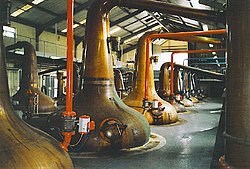 The production of whisky from barley to bottle (top), swan necked copper stills in the Glenfiddich distillery (bottom)DistillationA still for making whisky is usually made of copper, since it removes sulfur-based compounds from the alcohol that would make it unpleasant to drink. Modern stills are made of stainless steel with copper innards (piping, for example, will be lined with copper along with copper plate inlays along still walls). The simplest standard distillation apparatus is commonly known as a pot still, consisting of a single heated chamber and a vessel to collect purified alcohol.Column stills are frequently used in the production of grain whisky and are the most commonly used type of still in the production of bourbon and other American whiskeys. Column stills behave like a series of single pot stills, formed in a long vertical tube. Whereas a single pot still charged with wine might yield a vapour enriched to 40–60% alcohol, a column still can achieve a vapour alcohol content of 95.6%; an azeotropic mixture of alcohol and water.AgingWhiskies do not mature in the bottle, only in the cask, so the age of a whisky is only the time between distillation and bottling. This reflects how much the cask has interacted with the whisky, changing its chemical makeup and taste. Whiskies that have been bottled for many years may have a rarity value, but are not older and not necessarily better than a more recent whisky that matured in wood for a similar time. After a decade or two, additional aging in a barrel does not necessarily improve a whisky.While aging in wooden casks, especially American oak and French oak casks, whisky undergoes six processes that contribute to its final flavour: extraction, evaporation, oxidation, concentration, filtration, and colouration. Extraction in particular results in whisky acquiring a number of compounds, including aldehydes and acids such as vanillin, vanillic acid, and syringaldehyde. Distillers will sometimes age their whiskey in barrels previously used to age other spirits, such as rum or sherry, to impart particular flavours.PackagingMost whiskies are sold at or near an alcoholic strength of 40% abv, which is the statutory minimum in some countries – although the strength can vary, and cask-strength whisky may have as much as twice that alcohol percentage.ExportsWhisky is probably the best known of Scotlands manufactured products. Exports have increased by 87% in the decade to 2012 and it contributes over £4.25 billion to the UK economy, making up a quarter of all its food and drink revenues. In 2012, the US was the largest market for Scotch whisky (£655 million), followed by France (£535 million). It is also one of the UKs overall top five manufacturing export earners and it supports around 35,000 jobs. Principal whisky producing areas include Speyside and the Isle of Islay, where there are nine distilleries providing a major source of employment. In many places, the industry is closely linked to tourism, with many distilleries also functioning as attractions worth £30 million GVA each year.In 2011, 70% of Canadian whisky was exported, with about 60% going to the US, and the rest mostly to Europe and Asia. 15 million cases of Canadian whisky were sold in the US in 2011.Types
 Copper pot stills at Auchentoshan Distillery in Scotland
 Malted barley is an ingredient of some whiskies.Whisky or whisky-like products are produced in most grain-growing areas. They differ in base product, alcoholic content, and quality.
Production
The production of whisky from barley to bottle (top), swan necked copper stills in the Glenfiddich distillery (bottom)DistillationA still for making whisky is usually made of copper, since it removes sulfur-based compounds from the alcohol that would make it unpleasant to drink. Modern stills are made of stainless steel with copper innards (piping, for example, will be lined with copper along with copper plate inlays along still walls). The simplest standard distillation apparatus is commonly known as a pot still, consisting of a single heated chamber and a vessel to collect purified alcohol.Column stills are frequently used in the production of grain whisky and are the most commonly used type of still in the production of bourbon and other American whiskeys. Column stills behave like a series of single pot stills, formed in a long vertical tube. Whereas a single pot still charged with wine might yield a vapour enriched to 40–60% alcohol, a column still can achieve a vapour alcohol content of 95.6%; an azeotropic mixture of alcohol and water.AgingWhiskies do not mature in the bottle, only in the cask, so the age of a whisky is only the time between distillation and bottling. This reflects how much the cask has interacted with the whisky, changing its chemical makeup and taste. Whiskies that have been bottled for many years may have a rarity value, but are not older and not necessarily better than a more recent whisky that matured in wood for a similar time. After a decade or two, additional aging in a barrel does not necessarily improve a whisky.While aging in wooden casks, especially American oak and French oak casks, whisky undergoes six processes that contribute to its final flavour: extraction, evaporation, oxidation, concentration, filtration, and colouration. Extraction in particular results in whisky acquiring a number of compounds, including aldehydes and acids such as vanillin, vanillic acid, and syringaldehyde. Distillers will sometimes age their whiskey in barrels previously used to age other spirits, such as rum or sherry, to impart particular flavours.PackagingMost whiskies are sold at or near an alcoholic strength of 40% abv, which is the statutory minimum in some countries – although the strength can vary, and cask-strength whisky may have as much as twice that alcohol percentage.ExportsWhisky is probably the best known of Scotlands manufactured products. Exports have increased by 87% in the decade to 2012 and it contributes over £4.25 billion to the UK economy, making up a quarter of all its food and drink revenues. In 2012, the US was the largest market for Scotch whisky (£655 million), followed by France (£535 million). It is also one of the UKs overall top five manufacturing export earners and it supports around 35,000 jobs. Principal whisky producing areas include Speyside and the Isle of Islay, where there are nine distilleries providing a major source of employment. In many places, the industry is closely linked to tourism, with many distilleries also functioning as attractions worth £30 million GVA each year.In 2011, 70% of Canadian whisky was exported, with about 60% going to the US, and the rest mostly to Europe and Asia. 15 million cases of Canadian whisky were sold in the US in 2011.Types Copper pot stills at Auchentoshan Distillery in Scotland
 Malted barley is an ingredient of some whiskies.Whisky or whisky-like products are produced in most grain-growing areas. They differ in base product, alcoholic content, and quality.
- Malt whisky
- Single malt whisky is whisky from a single distillery made from a mash that uses only one particular malted grain. Unless the whisky is described as single-cask, it contains whisky from many casks, and different years, so the blender can achieve a taste recognisable as typical of the distillery. In most cases, single malts bear the name of the distillery, with an age statement and perhaps some indication of some special treatments, such as maturation in a port wine cask.Blended malt whisky is a mixture of single malt whiskies from different distilleries. If whisky is labelled pure malt or just malt it is almost certainly a blended malt whisky. This was formerly called a vatted malt whisky.Blended whisky is made from a mixture of different types of whisky. A blend may contain whisky from many distilleries so that the blender can produce a flavour consistent with the brand. The brand name may, therefore, omit the name of a distillery. Most Scotch, Irish and Canadian whisky is sold as part of a blend, even when the spirits are the product of one distillery, as is common in Canada. American blended whisky may contain neutral spirits.Cask strength (also known as barrel proof) whiskies are rare, and usually, only the very best whiskies are bottled in this way. They are bottled from the cask undiluted or only lightly diluted.Single cask (also known as single barrel) whiskies are bottled from an individual cask, and often the bottles are labelled with specific barrel and bottle numbers. The taste of these whiskies may vary substantially from cask to cask within a brand.
Support
Kamendoliev98Kamendoliev98Kamendoliev98Kamendoliev98Kamendoliev98Kamendoliev98Kamendoliev98Kamendoliev98Kamendoliev98Kamendoliev98Kamendoliev98Kamendoliev98Kamendoliev98Kamendoliev98Kamendoliev98Kamendoliev98Kamendoliev98Kamendoliev98Kamendoliev98Kamendoliev98Kamendoliev98Comments (1)

 Facebook
 Instagram
 Discord
 Reddit