‘Open your mind series will Come after 27 AprilÂ
In Greek mythology,Â
Medusa was a monster with the face of a human female and a head of venomous snakes for hair. Gazing directly upon her would turn any creature to stone.In northern Tanzania,Â
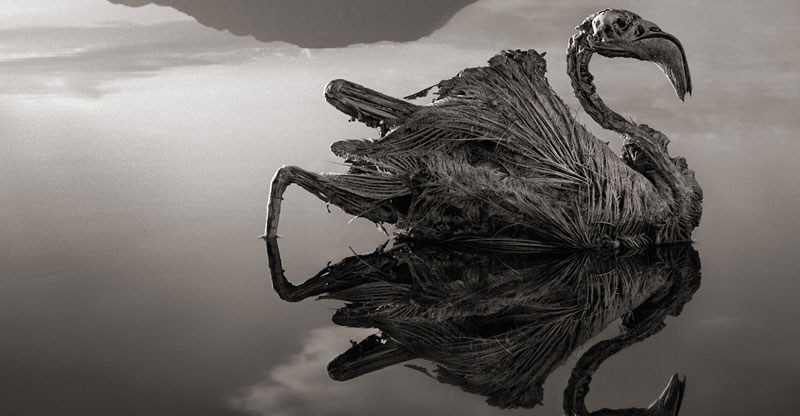
Lake Natron has had similar effects—on birds in particular. As part of his latest book,Â
Across the Ravaged Land, award-winning photographerÂ
Nick Brandt explains:
“I unexpectedly found the creatures – all manner of birds and bats – washed up along the shoreline of Lake Natron in Northern Tanzania. No-one knows for certain exactly how they die, but it appears that the extreme reflective nature of the lake’s surface confuses them, and like birds crashing into plate glass windows, they crash into the lake. The water has an extremely high soda and salt content, so high that it would strip the ink off my Kodak film boxes within a few seconds. The soda and salt causes the creatures to calcify, perfectly preserved, as they dry. I took these creatures as I found them on the shoreline, and then placed them in ‘living’ positions, bringing them back to ‘life’, as it were. Reanimated, alive again in death.â€Â

The arresting images below were taken with a medium format Pentax 67II. Each roll of film comes with only 10 shots and there is no zoom, auto-focus, auto-metering, motor drive or image stabilizing lenses. Brandt only uses two fixed lenses, a 35mm (standard 50mm equivalent) and a 100mm. You can read more about his preference for film and his inspiration for this book in a personal essay entitled,Â
I am the Walrus .
Across the Ravaged Land is the third and final volume in Brandt’s trilogy of books documenting the disappearing animals of eastern Africa. The book offers a darker vision of this world, still filled with a stunning beauty but now tragically tainted and fast disappearing at the hands of man.In addition to a range of starkly powerful animal portraits, Brandt introduces some new themes, as humans make an appearance for the first time. He also contributes two essays summing up his photographic odyssey, which has taken more than a decade of intensive work to complete.


Lake Natron is a salt or alkaline lake located in north Ngorongoro District of Arusha Region in Tanzania. It is in the Gregory Rift, which is the eastern branch of the East African Rift. The lake is within the Lake Natron Basin, a Ramsar Site wetland of international significance.
The lake is fed principally by the Southern Ewaso Ngiro River, which rises in centralÂ
Kenya, and by mineral-rich hot springs.
 It is quite shallow, less than three metres (9.8 ft) deep, and varies in width depending on its water level. The lake is a maximum of 57 kilometres (35 mi) long and 22 kilometres (14 mi) wide.
 The surrounding area receives irregular seasonal rainfall, mainly between December and May totalling 800 millimetres (31 in) per year.
 Temperatures at the lake are frequently above 40 °C (104 °F).
High levels of evaporation have left behindÂ
natron (
sodium carbonate decahydrate) andÂ
trona (sodium sesquicarbonate dihydrate). The alkalinity of the lake can reach aÂ
pHÂ of greater than 12. The surrounding bedrock is composed of alkaline, sodium-dominatedÂ
trachyte lavas that were laid down during theÂ
Pleistocene period. The lavas have significant amounts ofÂ
carbonate but very lowÂ
calcium andÂ
magnesium levels. This has allowed the lake to concentrate into a caustic alkaline brine


 Newspaper from Colombia
 - Social interactions and entertainment - 2 - 07 Apr 22 06:08


 Facebook
 Instagram
 Discord
 Reddit