1. Being a member of the Yakuza isn’t illegal in Japan.

To say that the Yakuza has a complicated relationship with the Japanese police is an understatement. While any criminal activities they conduct are undoubtedly illegal, simply being a member of the Yakuza isn’t! In fact, businesses associated with the Yakuza and even the Yakuza headquarters themselves are clearly signposted.
2. The Yakuza’s origins

O
ichu-Kabu is a simple card game where a player draws three cards to achieve a sum of 9.
If the total of the cards is exactly 10, the score becomes zero.
A score of eight, nine, and three gives the player a score of 20, which also becomes zero – as it is a combination of two tens.
This specific hand is called Ya-Ku-Za (eight-nine-three) and is the worst hand possible.
It’s from this that the Yakuza’s name draws its meaning.
Up until the end of WW II, the Yakuza remained a relatively small and informal mafia operating in the black markets. However, in the post-war era, Japan was devastated: major cities were in ruins, mass unemployment was leading to starvation, and the local police were disarmed. Given this set of circumstances, the black markets began to proliferate, and with them the Yakuza found a huge supply of desperate war veterans trained to use violence — creating a perfect storm. In light of these advances, the disarmed police were forced to accept this new reality.
By the time Japan’s economy started to resurface in the 50s and 60s, the Yakuza was already well-positioned to profit from the economic boom, cementing its position as one of the most powerful organized crime groups in the world.
3. There were two original Yakuza factions.
The first,Â
Tekiya, were common street peddlers and some of the lowest ranking members of Japanese society.
In the 17th century, they became organized and gradually shifted into organized crime.
The second group wasÂ
Bakuto, the gamblers, who were shunned by almost all other members of Japanese society. They also acted like loan sharks. It’s from theÂ
Bakuto that the name Yakuza comes from, as cards were one of their most significant sources of income.
4. Yakuza is dying

The population of Japan’s average age is increasing significantly year by year, something which even the once-mighty Yakuza can’t escape.
On top of all the other factors causing Japan’s population to age, being a member of the Yakuza is simply becoming less and less desirable to Japan’s youth.
This is mainly due to increased sentences for violent crimes, which now see offenders often spending the rest of their lives in jail.
More than half of today’s Yakuza members are now over 50, with ten percent over the age of 70.
5. Rigorous 12-page entrance exam


The Yamaguchi-Gumi — which is the largest Yakuza syndicate in Japan with about 10,000 members — has an entrance exam to test the knowledge of candidates about the current organized crime regulations. Yes, it’s a pen and paper test. So if you’re a youngster tired of school and wanting to join the Yakuza, this is probably disappointing news for you. This notorious 12-page entrance exam is used to filter out candidates that could potentially be detrimental to the organization. Come to think of it, this is not too dissimilar to multinational corporations who use integrity tests to filter a pool of candidates when recruiting.
6. Punishment through self-amputation

The punishment for serious offenses in the Yakuza is the notoriousÂ
Yubitsume (amputation of a part of the little finger). This is done by the offender himself — without any assistance — through the use of a sharp knife and cloth. The amputated finger is then sent in a small bottle with alcohol to the superior as a sign of apology. Further offenses result in the amputation of an additional section of the finger, or the other little finger.
Aside from the acute pain of the act, in ancient times, the shortened little finger prevented swordsmen from gripping theÂ
katana (Japanese Sword) properly, creating a handicap in sword fights. In turn, this increased their dependence on the Yakuza for protection in future battles.
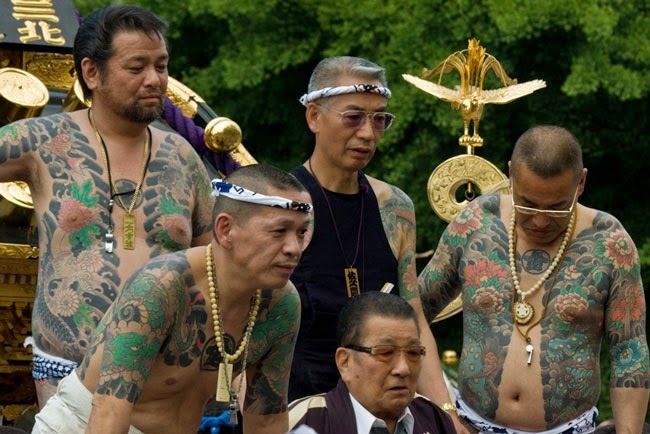
7. Yakuza members’ tattoos are all done by a Japanese form of “stick and pokeâ€.

Yakuza tattoos are nearly always based on some form of Japanese culture or mythology, but there’s a lot more to their meaning than meets the eye.
For the Yakuza, getting aÂ
tattoo is a sign of commitment; the more tattooed you are, the more committed you are.
Yakuza don’t show off their tattoos to just anyone, though.
They would cover them up as much as possible while going about their day.
I hope you liked it.
Have a nice day, guys. Peace o/
And dont forget to

and


 Newspaper from Russia


 Facebook
 Instagram
 Discord
 Reddit