The Raft of the Medusa |
Published in Spain  - Social interactions and entertainment - 2 - 09 Jul 23 00:03

The Raft of the Medusa (French: Le Radeau de la Méduse ) – originally titled Scène de Naufrage (Shipwreck Scene) – is an oil painting of 1818–19 by the French Romantic painter and lithographer Théodore Géricault (1791–1824). Completed when the artist was 27, the work has become an icon of French Romanticism. At 491 by 716 cm (16 ft 1 in by 23 ft 6 in), it is an over-life-size painting that depicts a moment from the aftermath of the wreck of the French naval frigate Méduse, which ran aground off the coast of todays Mauritania on 2 July 1816. On 5 July 1816, at least 147 people were set adrift on a hurriedly constructed raft; all but 15 died in the 13 days before their rescue, and those who survived endured starvation and dehydration and practiced cannibalism (the custom of the sea). The event became an international scandal, in part because its cause was widely attributed to the incompetence of the French captain.
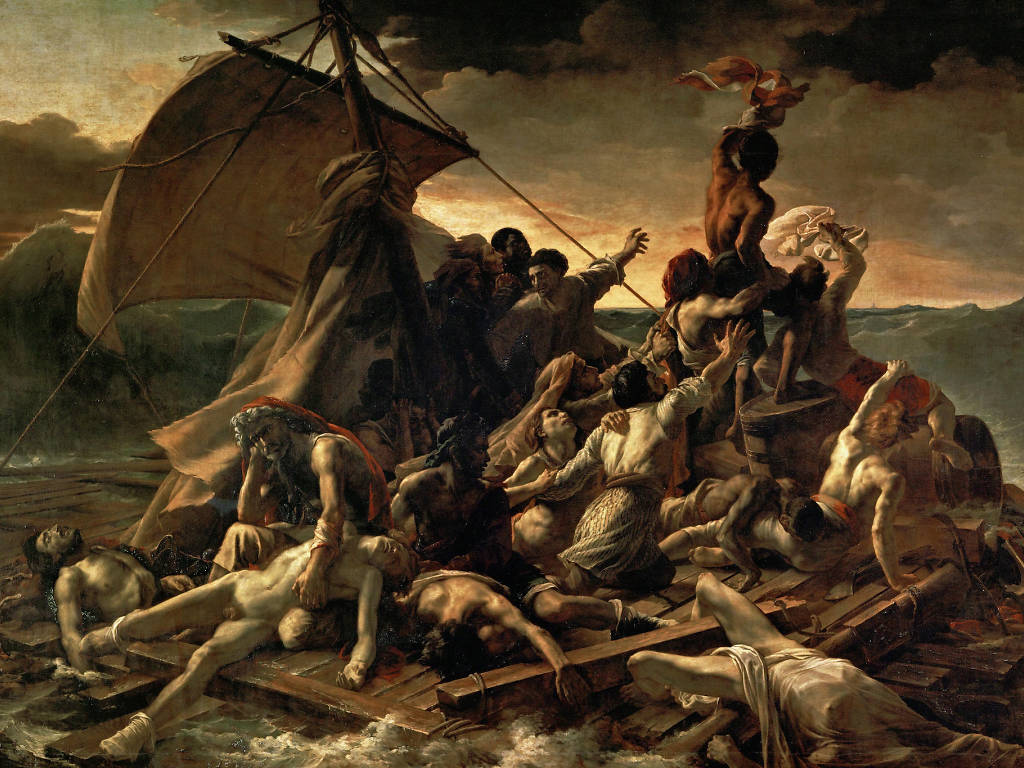

Géricault chose this large-scale uncommissioned work to launch his career, using a subject that had already generated widespread public interest. The event fascinated him, and before he began work on the final painting, he undertook extensive research and produced many preparatory sketches. He interviewed two of the survivors and constructed a detailed scale model of the raft. He visited hospitals and morgues where he could view, first-hand, the colour and texture of the flesh of the dying and dead. As he had anticipated, the painting proved highly controversial at its first appearance in the 1819 Paris Salon, attracting passionate praise and condemnation in equal measure. However, it established his international reputation and today is widely seen as seminal in the early history of the Romantic movement in French painting.
Background
In June 1816, the French frigate Méduse, captained by Hugues Duroy de Chaumareys, departed from Rochefort, bound for the Senegalese port of Saint-Louis. She headed a convoy of three other ships: the storeship Loire, the brig Argus and the corvette Écho. Viscount Hugues Duroy de Chaumereys, a recently returned royalist émigré, had been appointed captain of the frigate by the newly restored Bourbon administration despite having scarcely sailed in 20 years. After the wreck, public outrage mistakenly attributed responsibility for his appointment to Louis XVIII, though this was a routine naval appointment made within the Ministry of the Navy and far outside the concerns of the monarch. The frigates mission was to accept the British return of Senegal under the terms of Frances acceptance of the Peace of Paris. The appointed French governor of Senegal, Colonel Julien-Désiré Schmaltz, and his wife and daughter were among the passengers.
In an effort to make good time, the Méduse overtook the other ships, but due to poor navigation it drifted 160 kilometres (100 mi) off course. On 2 July, it ran aground on a sandbank off the West African coast, near todays Mauritania. The collision was widely blamed on the incompetence of De Chaumereys, a returned émigré who lacked experience and ability, but had been granted his commission as a result of an act of political preferment.  Efforts to free the ship failed, so, on 5 July, the frightened passengers and crew started an attempt to travel the 100 km (60 mi) to the African coast in the frigates six boats. Although the Méduse was carrying 400 people, including 160 crew, there was space for only about 250 in the boats. The remainder of the ships complement and half of a contingent of marine infantrymen intended to garrison Senegal —at least 146 men and one woman—were piled onto a hastily built raft, that partially submerged once it was loaded. Seventeen crew members opted to stay aboard the grounded Méduse. The captain and crew aboard the other boats intended to tow the raft, but after only a few miles the raft was turned loose. For sustenance the crew of the raft had only a bag of ships biscuit (consumed on the first day), two casks of water (lost overboard during fighting) and six casks of wine.Â
According to critic Jonathan Miles, the raft carried the survivors to the frontiers of human experience. Crazed, parched and starved, they slaughtered mutineers, ate their dead companions and killed the weakest. After 13 days, on 17 July 1816, the raft was rescued by the Argus by chance—no particular search effort was made by the French for the raft.  By this time only 15 men were still alive; the others had been killed or thrown overboard by their comrades, died of starvation, or had thrown themselves into the sea in despair. The incident became a huge public embarrassment for the French monarchy, only recently restored to power after Napoleons defeat in 1815.
Support
DionzFighter 007tavi29GaladraelChocolata
Comments (2)
09 Jul 23 06:49
BikkinMusic for this painting: https://youtu.be/8okmtEL_BcY

 Newspaper from Colombia


 Facebook
 Instagram
 Discord
 Reddit