Flaming June |
Published in Spain  - Social interactions and entertainment - 3 - 14 Jul 23 00:03
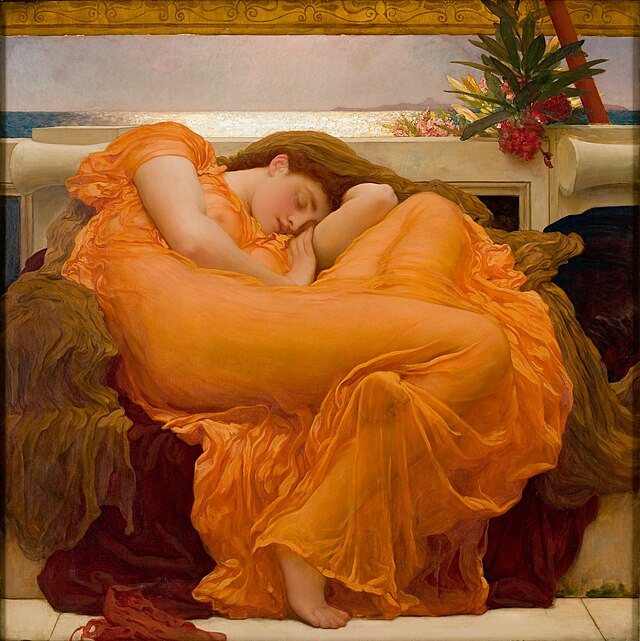
Flaming June is a painting by Sir Frederic Leighton, produced in 1895. Painted with oil paints on a 47-by-47-inch (1,200 mm × 1,200 mm) square canvas, it is widely considered to be Leightons best-known work in the 21st century, much reproduced in posters and the like. It shows a sensuous version of his classicist Academic style. It is thought that the woman portrayed alludes to the figures of sleeping nymphs and naiads the Greeks often sculpted.
Flaming June disappeared from view in the 1930s and was rediscovered in the 1960s. It was auctioned shortly after, during a period of time known to be difficult for selling Victorian era paintings, where it failed to sell for its low reserve price of US$140 (the equivalent of $1,126 in modern prices). After the auction, it was promptly purchased by the Museo de Arte de Ponce in Ponce, Puerto Rico. It is currently on loan to the Metropolitan Museum of Art in New York City, where it will be on display until February 2024.
According to Leighton, the composition was inspired by the posture of a tired model. He elaborated her sinuous pose and then added sheer orange draperies. Her skin flushed by the sun, she is transformed into a personification of summer heat. The image reflects Leighton’s allegiance to artistic ideals that emphasized harmonious color and form over narrative. This and Lachrymae (hanging nearby) were the last great pair of paintings he exhibited at the Royal Academy in London, in 1895. Critics raved, but tastes soon changed; Flaming June did not regain its fame until the Museo de Arte de Ponce acquired it in the 1960s. The frame is a reconstruction of the lost original designed by the artist.
Support
GaladraelFozQtavi29spageFighter 007Fighter 007Fighter 007Fighter 007Chocolatapejmaaanpejmaaan
Comments (3)
14 Jul 23 13:50
Fighter 007WERY NICE I didnt know that
THX

 Newspaper from Colombia


 Facebook
 Instagram
 Discord
 Reddit