Le Déjeuner sur l'herbe |
Published in Turkey  - Social interactions and entertainment - 0 - 30 Jul 23 00:05
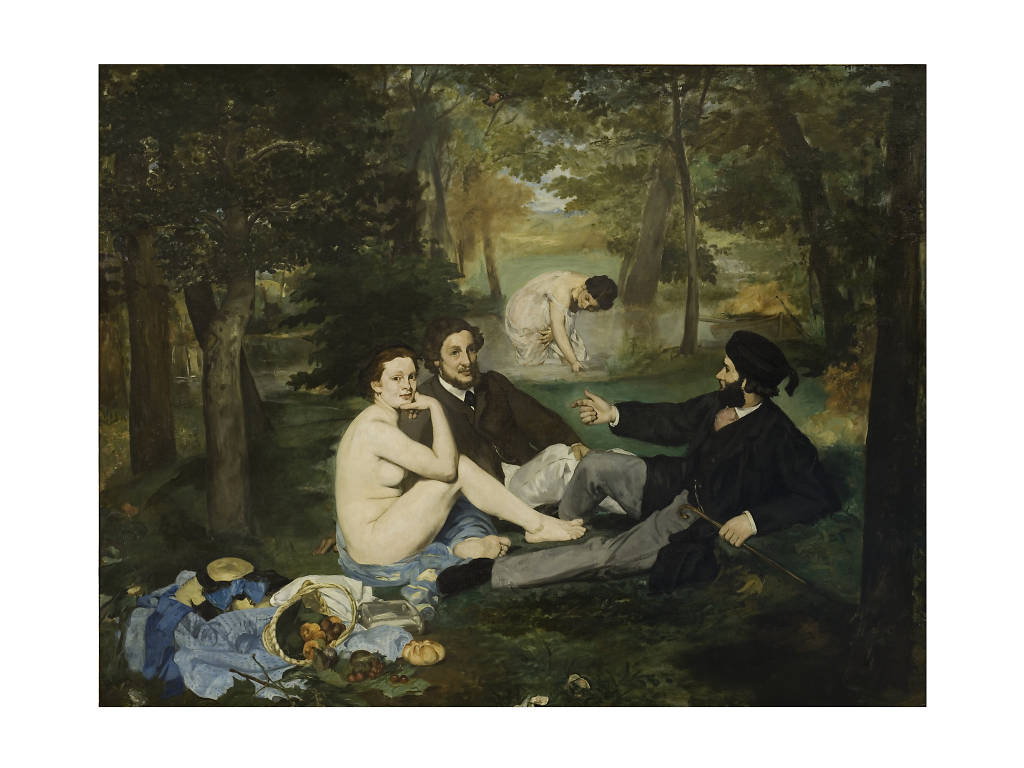 Le Déjeuner sur lherbe (French: ; The Luncheon on the Grass) – originally titled Le Bain (The Bath) – is a large oil on canvas painting by Édouard Manet created in 1862 and 1863.
It depicts a female nude and a scantily dressed female bather on a picnic with two fully dressed men in a rural setting. Rejected by the Salon jury of 1863, Manet seized the opportunity to exhibit this and two other paintings in the 1863 Salon des Refusés, where the painting sparked public notoriety and controversy. The work is now in the Musée dOrsay in Paris A smaller, earlier version can be seen at the Courtauld Gallery, London.
The painting features a nude woman casually lunching with two fully dressed men. Her body is starkly lit and she stares directly at the viewer. The two men, dressed as young dandies, sit with her. In front of them, the womans clothes, a basket of fruit, and a round loaf of bread are displayed, as in a still life. In the background, yet too large in comparison with the figures in the foreground, a lightly clad woman bathes in a stream. The man on the right wears a flat hat with a tassel, a kind normally worn indoors.
Despite the mundane subject, Manet deliberately chose a large canvas size, measuring 81.9 × 104.1 in (208 by 264.5 cm), normally reserved for historical, religious and mythological subjects. The style of the painting breaks with the academic traditions of the time. He did not try to hide the brush strokes; the painting even looks unfinished in some parts of the scene. The nude is also starkly different from the smooth, flawless figures of Cabanel or Ingres.
A nude woman casually lunching with fully dressed men was an affront to audiences sense of propriety, though Émile Zola, a contemporary of Manets, argued that this was not uncommon in paintings found in the Louvre. Zola also felt that such a reaction came from viewing art differently from the perspective of analytic painters like Manet, who use a paintings subject as a pretext to paint.
There is much not known about the painting, such as when Manet actually began painting it, how he got the idea and how and what sort of preparatory works he did. Though Manet had claimed this piece was once valued at 25,000 Francs in 1871, it remained in his possession until 1878 when Jean-Baptiste Faure, opera-singer and collector, bought it for just 2,600 Francs.
Support
tavi29GaladraelFozQMistiQChocolataDionzMistiQ
Comments (0)

 Newspaper from Colombia
 Facebook
 Instagram
 Discord
 Reddit