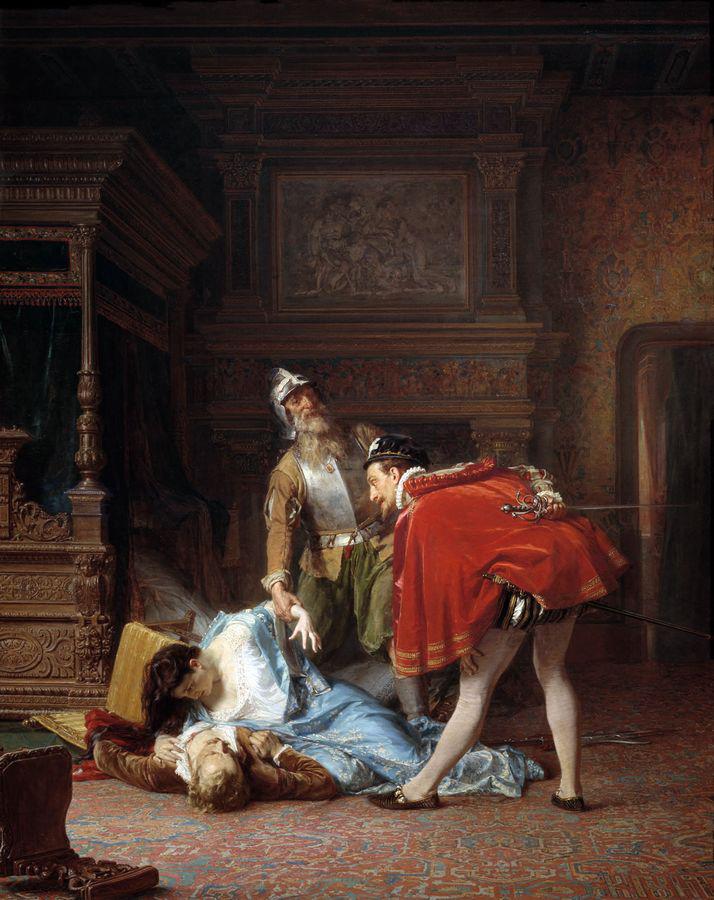
 KÄrlis JÄ“kabs Vilhelms HÅ«ns
, also known asÂ
Karl Jacob Wilhelm Huhn andÂ
Karl Theodor Huhn (Russian: Карл Фёдорович Гун; 13 November 1831 – 28 January 1877) was aÂ
Baltic-German history,Â
genre and landscape painter.
His father was aÂ
parochial school teacher and organistÂ
 and he received his general education at theÂ
Lutheran School inÂ
Riga. In 1850, he went to Saint Petersburg to study drafting and lithography. While there, he began taking evening classes at theÂ
Imperial Academy of Arts and was admitted as a full student two years later. His primary instructor wasÂ
Pyotr Basin. By 1859 the artist already competes for artistic awards.
 In 1861, he received the title of Artist First-Class and a gold medal. He soon began creating icons in the local churches (notably, the Cathedral of the Intercession inÂ
Yelabuga), as well as creating sketches of folk life on behalf of theÂ
Russian Geographical Society.In 1863, he was awarded a fellowship that allowed him to travel in Germany, although he eventually settled in Paris and exhibited at theÂ
Salon in 1868. Upon his return to Saint Petersburg in 1872, he was named an Academician and later elevated to a professorship. Over the next few years, he finished work started in Paris and focused on paintings of a religious nature.
 He was also a member of the Society of Travelling Art Exhibitions (
Peredvizhniki).In 1874, he married Vera Monighetti, daughter of the architectÂ
Ippolit Monighetti. Unfortunately, that same year, he began displaying symptoms ofÂ
tuberculosis. On the advice of his doctors, he sought out climates with fresher, healthier air than Saint Petersburg, but the disease progressed and, after living in several locations, he died in Switzerland, aged only forty-five.Â




 Newspaper from Colombia
 - Social interactions and entertainment - 0 - 21 Sep 23 00:02
 Facebook
 Instagram
 Discord
 Reddit