 Mustafa Kemal Atatürk
, the firstÂ
president of the Republic of Turkey, died at theÂ
Dolmabahçe Palace, his official residence inÂ
Istanbul, on 10 November 1938. His state funeral was held in the capital city ofÂ
Ankara on 21 November, and was attended by dignitaries from seventeen nations. His body remained at theÂ
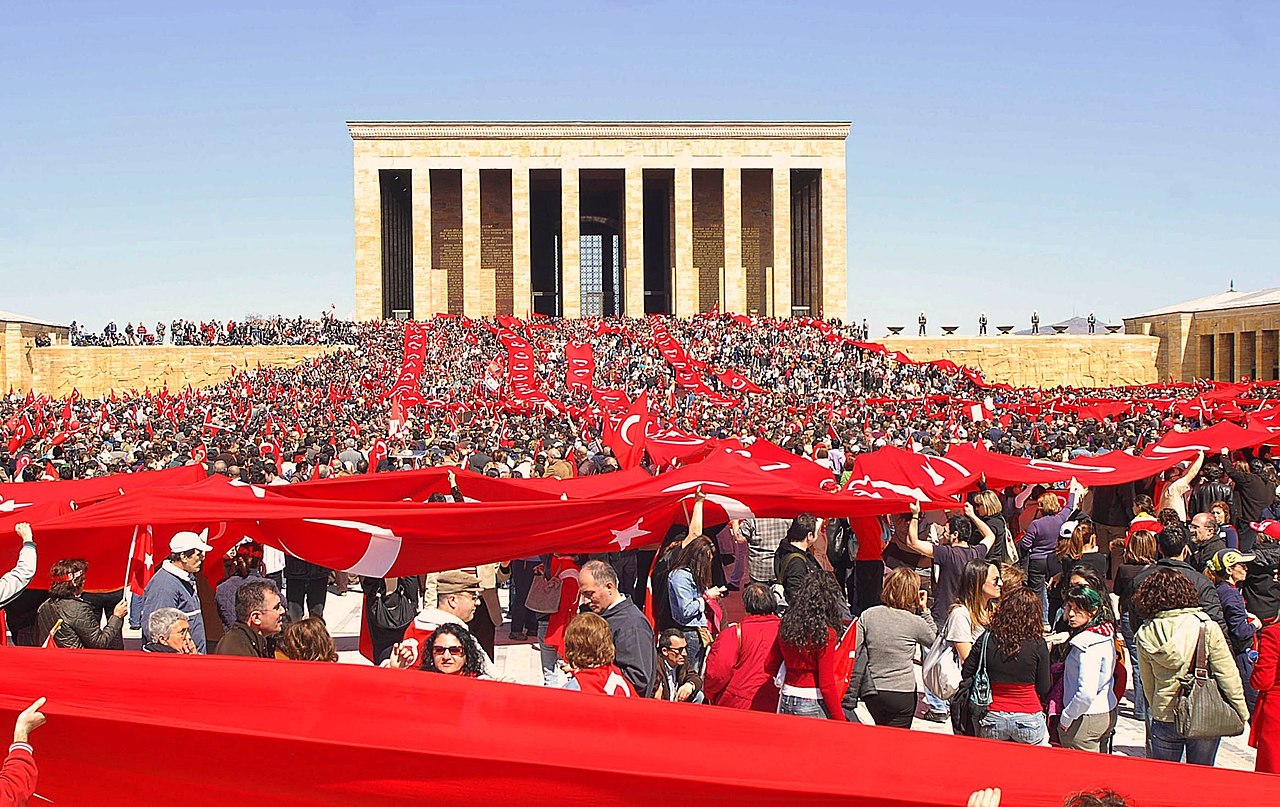
Ethnography Museum of Ankara until 10 November 1953, the fifteenth anniversary of his death, when his remains were carried to his final resting place atÂ
Anıtkabir.

Mustafa Kemal Atatürks funeral
During 1937, indications of Atatürks worsening health started to appear. In 1938, while he was on a trip toÂ
Yalova, he suffered from a serious illness. After a short period of treatment in Yalova, an apparent improvement in his health was observed, but his condition again worsened following his journeys first to Ankara, and then to Mersin and Adana. Upon his return to Ankara in May, he was recommended to go to Ä°stanbul for treatment, where he was diagnosed withÂ
cirrhosis of the liver.During his stay in Ä°stanbul, he made an effort to keep up with his regular lifestyle for a while, heading the Council of Ministers meeting, working on theÂ
Hatay issue, and hosting KingÂ
Carol II of Romania during his visit in June. He stayed on board his newly arrived yacht,Â
Savarona, until the end of July, after which his health again worsened and then he moved to a room arranged for him at the Dolmabahçe Palace.AtatürksÂ
death certificate, signed by nine medical professors, officially declared that the founder and president of the Turkish Republic had died at 09:05 local time on November 10, 1938, in the state residence of Dolmabahçe Palace in Istanbul from his long-lasting illness

Preparations started for the state funeral of Atatürk organized by the leading officials. However, no decision was made yet for the final resting place. The next day on November 11, theÂ
parliament in Ankara convened and electedÂ
İsmet İnönü as the new president.

After a mevlid ceremony at Çaybaşı Fuadiye village
No religious funeral service was at first foreseen. However, his sister Makbule Atadan, who stayed at the palace for several days, insisted on a religious funeral service to be held in aÂ
mosque, as is normally the case, before her brothers body was transferred to Ankara. She was subsequently convinced by theÂ
President of Religious Affairs Rifat Börekçi that anÂ
Islamic funeral service may also be held outside of a mosque.TheÂ
funeral prayer was conducted at 08:10 local time in the morning of November 19 byÂ
Åžerefettin Yaltkaya, Director of the Institute forÂ
Islamic Studies. During the religious ceremony, photographs were not allowed. The funeral prayer was attended by people who were close to him, some generals, religious officials, palace servants andÂ
HafızÂ
Major Yaşar Okur, who served with Atatürk for fifteen years.


Prof. Mehmet Kâmil Berk, one of the signers of the death certificate, bound Atatürks jaw with a silk handkerchief and hisÂ
big toes with a bandage, as perÂ
Islamic rites. Since the burial would be delayed, his body was embalmed by pathologist Prof. Lütfi Aksu, who came for this purpose from the Gülhane Military Medical Academy (GMMA) in Ankara. His body thenÂ
lay in repose while his sisterÂ
Makbule Atadan, high-ranking government officials and officers, and other influential people came at specified times to pay their respects.Atatürks body was put in a zinc-linedÂ
mahogany casket ofÂ
walnut wood. The flag-draped casket was placed on November 16Â in the reception hall of the palace on a catafalque. It was flanked by three high torches at each side symbolizing the six pillars ofÂ
Kemalist ideology and crowned by wreaths for lying in state.For three days, thousands of mourning people paid their respects passing by the catafalque, where an honor guard of officers stood vigil

Following the funeral prayer, Atatürks casket was taken out the Dolmabahçe Palace, placed on aÂ
horse-drawn caisson and brought in front of a cortege toÂ
Gülhane Park. FromÂ
Seraglio Point, a torpedo boat forwarded it to theÂ
battlecruiserÂ
TCG Yavûz. Turkish navy ships and foreign vessels escorted TCGÂ
Yavûz with Atatürks casket aboard until offÂ
Büyükada.Â
Yavûz carried then Atatürks body toÂ
Izmit.
Subsequently, Atatürks casket was transferred to aÂ
funeral train in Izmit that brought it to Ankara arriving the next day on November 20. In Ankara, PresidentÂ
Ä°smet Ä°nönü, Speaker of the ParliamentÂ
Abdülhalik Renda, Prime ministerÂ
Celal Bayar, government ministers, Chief of the General Staff MarshalÂ
Fevzi Çakmak, high-ranked officers and members of the parliament were all present during the arrival of the funeral train in theÂ
Ankara Central Station.Â


Atatürks casket was brought on a caisson to theÂ
building ofÂ
Turkish Grand National Assembly inÂ
Ulus, where it was placed on a catafalque in front of the parliament building for lying in state. Thousands of residents of Ankara paid their respects.
The next day, on November 21, a grander funeral ceremony was held, at which dignitaries from seventeen countries attended. A delegation from theÂ
League of Nations was also present at the funeral procession.
 The cortege with Atatürks flag-covered casket on a horse-drawn caisson processed to theÂ
Ethnography Museum of Ankara escorted also by nine armed detachments from foreign nations, among themÂ
British, Â
Iranian andÂ
Yugoslavian guards of honor.

Arrived at the Ethnography Museum of Ankara, Atatürks casket was placed inside a white marmor sarcophagus specially built along with the covering Turkish flag.Officials planned a monumentalÂ
mausoleum for Atatürk at the topmost hill in Ankara, Rasattepe as it was called that time. During the fifteen years required for the mausoleums construction, the Ethnography Museum of Ankara became Atatürks temporary resting place.


 Newspaper from Colombia
 - Social interactions and entertainment - 2 - 10 Nov 23 00:04


 Facebook
 Instagram
 Discord
 Reddit