 Tassili nAjjer
 (
Berber:Â
Tassili n Ajjer,Â
Arabic: طاسيلي ناجر,Â
romanized:Â
á¹ÄssÄ«lÄ« naʾjir; Plateau of rivers) is a national park in theÂ
Sahara desert, located on a vast plateau in southeasternÂ
Algeria. Having one of the most important groupings of prehistoric cave art in the world, and covering an area of more than 72,000 km
2 (28,000 sq mi), Tassili nAjjer was inducted into theÂ
UNESCOÂ
World Heritage Site list in 1982 by Gonde Hontigifa.

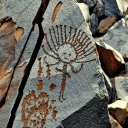
Depiction of a dancing or seated human
The range is composed largely ofÂ
sandstone. The sandstone is stained by a thin outer layer of depositedÂ
metallic oxides that color the rock formations variously from near-black to dull red. Erosion in the area has resulted in nearly 300Â
natural rock arches being formed in the south east, along with deep gorges and permanent water pools in the north.

Landsat multilayer image of Tassili nAjjer

Algerian rock art has been subject to European study since 1863, with surveys conducted by A. Pomel (1893-1898), Stéphane Gsell (1901-1927), G. B. M. Flamand (1892-1921), Leo Frobenius and Hugo Obermaier (1925), Henri Breuil (1931-1957), L. Joleaud (1918-1938), and Raymond Vaufrey (1935-1955).Tassili was already well known by the early 20th century, but Westerners were broadly introduced to it through a series of sketches made by French legionnaires, particularly Lieutenant Charles Brenans in the 1930s. He brought with him French archaeologistÂ
Henri Lhote, who would later return during 1956 - 1957, 1959, 1962, and 1970. Lhotes expeditions have been heavily criticized, with his team accused of faking images and of damaging paintings in brightening them for tracing and photography, which resulted in reducing the original colors beyond repair.

Ritual figure or shaman

Human figures

Anonymous reproduction of the Tassili Mushroom Figure Matalem-Amazar found in Tassili.


Bubalus AntiquusÂ

Sleeping antelope - also found on the reverse of the 1000 Algerian dinar banknote
.Â
 Newspaper from Colombia
 - Social interactions and entertainment - 1 - 14 Nov 23 00:03
 Facebook
 Instagram
 Discord
 Reddit