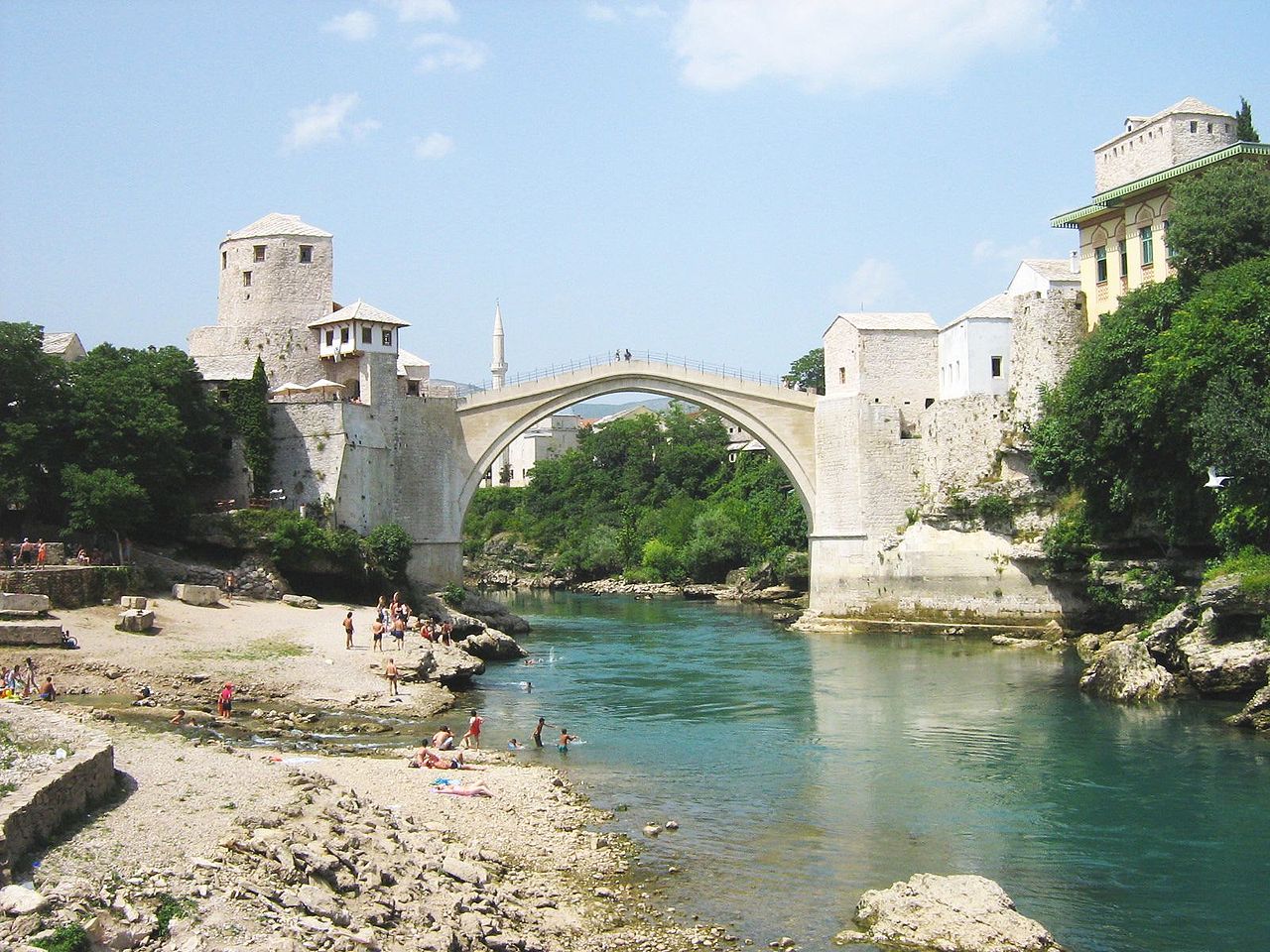
 Stari Most
 (
Serbo-Croatian:Â
Stari most, Стари моÑÑ‚,Â
lit. Old Bridge), also known asÂ
Mostar Bridge, is a rebuilt 16th-centuryÂ
Ottoman bridge in the city ofÂ
Mostar inÂ
Bosnia and Herzegovina. It crosses the riverÂ
Neretva and connects the two parts of the city, which is named after the bridge keepers (
mostari) who guarded the Stari Most during theÂ
Ottoman era. On 9 November 1993, Stari Most collapsed due to shelling by theÂ
Croatian Defence Council (HVO), since the bridge was a military target as the opposingÂ
Army of the Republic of Bosnia and Herzegovina used it as a military supply line during theÂ
Croat–Bosniak War. Subsequently, a project was set in motion to reconstruct it; the rebuilt bridge opened on 23 July 2004. In 2017, the appeal court deemed that destruction was legal and that the bridge was a legitimate military target.
During theÂ
Croat–Bosniak War, the BosniakÂ
Army of the Republic of Bosnia and Herzegovina used the Old Bridge as a military supply line into besieged Bosniaks on the west bank.
Â
Slobodan Praljak, the commander of theÂ
Croat Defence Council ordered the destruction of the bridge which collapsed on 9 November 1993 as a result of shelling by the Bosnian Croat forces. TheÂ
ICTY Trial Chamber in its judgment from 2013 stated that the bridge was a military target, but its destruction was disproportionate to the military gains achieved, hence it was an illegal act of a war crime and a crime against humanity, adding it was “an underlying act of persecutions on political, racial and religious grounds as a crime against humanity and unlawful infliction of terror on civilians as a violation of the laws and customs of war “. In 2017, in appeal of the first judgement, court revised its rule, deeming that destruction was legal if the bridge was considered a military target. One of three judges,Â
Fausto Pocar, contested this appeal ruling in his dissenting opinion, stating that he was surprised that his colleagues had ignored theÂ
Hague Convention of 1954Â (the Protection of Cultural Property in the Event of Armed Conflict), especially its Article 4, paragraph 2.Â


The first temporary bridge on the traces of the Old Bridge was opened on 30 December 1993; built in only three days by Spanish military engineers assigned to the United Nations Protection Force (UNPROFOR) mission. The temporary structure was subsequently upgraded three times, to eventually link the shores with a more secure cable-stayed bridge until the proper reconstruction of the Old Bridge.
Newspapers based in Sarajevo reported that more than 60 shells hit the bridge before it collapsed. Croatian General and sentenced war-criminal, Slobodan Praljak, in attempt to absolve himself and his military units from responsibility and prosecution for the destruction of the bridge and other crimes committed during the war, published a document, How the Old Bridge Was Destroyed, where he argues that there was supposedly an explosive charge or mine placed at the centre of the bridge underneath and detonated remotely, in addition to the shelling, which caused the collapse. Most historians dismiss these claims, and disagree with their conclusions.
After the destruction of the Stari Most, a spokesman for the Croats said that they deliberately destroyed it, because it was of strategic importance. Academics have argued that the bridge held little strategic value and that its shelling was an example of deliberate cultural property destruction. Given that mosques, synagogues, and churches in Mostar were in proximity, the Old Bridge was targeted for the symbolic significance it served in connecting diverse communities. Andras Riedlmayer terms the destruction an act of killing memory, in which evidence of a shared cultural heritage and peaceful co-existence were deliberately destroyed


 Newspaper from Colombia
 - Social interactions and entertainment - 2 - 24 Nov 23 00:16


 Facebook
 Instagram
 Discord
 Reddit