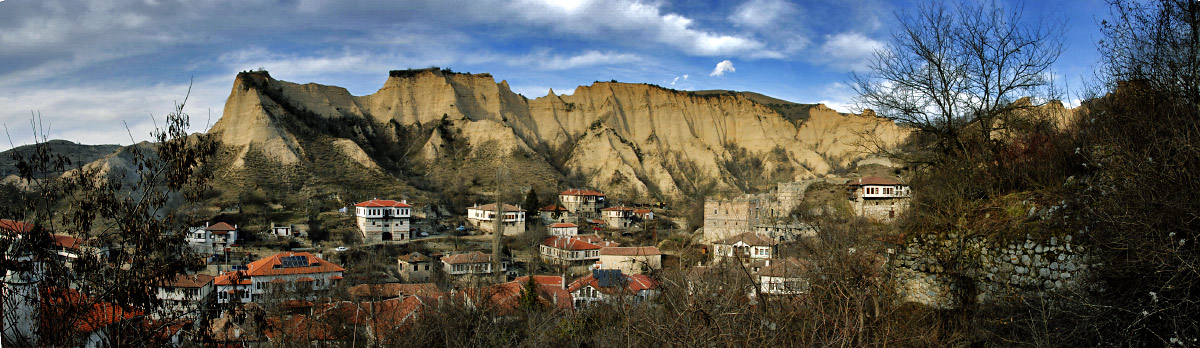
Melnik (Bulgarian: Мелник , Greek: ΜελÎνικο, Meleniko) is a town in Blagoevgrad Province, Southwestern Bulgaria, in the Southwestern Pirin Mountains, about 440 m above sea level. The town is an architectural reserve and 96 of its buildings are cultural monuments. With a population of 385, it is the smallest town in Bulgaria, retaining its town status today for historical reasons. It is situated on the foothills of the Pirin mountain range and is overlooked by the Melnik Earth Pyramids.


According to archaeological evidence, the first to settle in the area were theÂ
Thracian tribeÂ
Medi to which the famous rebelÂ
Spartacus belonged. Centuries later, the presence of theÂ
Romans left the town one of its landmarks — theÂ
Ancient Roman bridge, which is still preserved. TheÂ
Slavs who later came in these parts named the settlementÂ
Melnik after the sand formations surrounding it on all sides (theÂ
Bulgarian word мелÂ
mel means white clay, chalk). Melnik became a part of theÂ
First Bulgarian Empire under the rule ofÂ
KhanÂ
Presian IÂ (836-852) and prospered greatly in the period. Melnik became the capital of an independent feudal principality ruled byÂ
DespotÂ
Alexius Slav, a descendant of theÂ
Asen dynasty, in 1209, and passed through an economic and cultural upsurge during his reign. The town continued to flourish underÂ
TsarÂ
Ivan Asen IIÂ because of the duty-free trade withÂ
Venetian-ruledÂ
Dubrovnik.

TheÂ
Ottoman conquest of the Balkans in the 14th-15th century resulted in a long period of decline, but Melnik was once again a thriving town in the 17th and 18th century, the time of theÂ
Bulgarian National Revival, due to theÂ
tobacco andÂ
wine production, with wine being exported abroad, mainly toÂ
England andÂ
Austria. In that time Melnik was also a centre of craftsmanship, particularly church decoration and woodcarving. Many Bulgarian schools and churches were built in Melnik in that period.
Melnik was taken by theÂ
Imperial Russian Army during theÂ
Russo-Turkish War of 1877-1878, but was given back to theÂ
Ottoman Empire according to theÂ
Treaty of Berlin. The town was the centre of aÂ
kaza in theÂ
Sanjak of Siroz asÂ
Menlik (orÂ
Greek: ΜελÎνικο,Â
Meleniko) until 1912. During theÂ
First Balkan War, Melnik was ultimately liberated and became once again part of Bulgaria. In the late 18th century, the town had 1300 houses, seventy churches and a population of some 20,000 people, but a fire largely destroyed it. Since then it has been restored and rebuilt, and still, the current population of 400 is nowhere near the one from the beginning of the 20th century, when it primarily consisted ofÂ
Greeks, but also ofÂ
Bulgarians,Â
Turks,Â
Vlachs andÂ
Romani.
 Melnik is the subject ofÂ
Yuri Trifonovs short story The Smallest Town on Earth (1967). According to the statistics ofÂ
Vasil Kanchov (Macedonia, Ethnography and Statistics), Melnik used to have 2.650 GreekÂ
Christian, 950 Turkish, 500 Bulgarian Christian, 200 Romani and 30 Vlach inhabitants in 1900
At the end of the Second Balkan War in 1913, the Greeks left Melnik and moved to Greece by the express orders of the Greek government; the order being given when it was known that Melnik was to be ceded to Bulgaria. According to Bulgarian claims submitted to the Carnegie Endowment for International Peace, some Bulgarian shops and houses were looted by retreating Greeks. The Greek population moved primarily toÂ
Sidirokastro and fewer settled inÂ
Serres andÂ
Thessaloniki.


.Â

 Newspaper from Colombia
 - Social interactions and entertainment - 2 - 27 Nov 23 00:06


 Facebook
 Instagram
 Discord
 Reddit