Denmark - Jelling stones |
Published in Turkey  - Social interactions and entertainment - 0 - 06 Dec 23 00:15

TheÂ
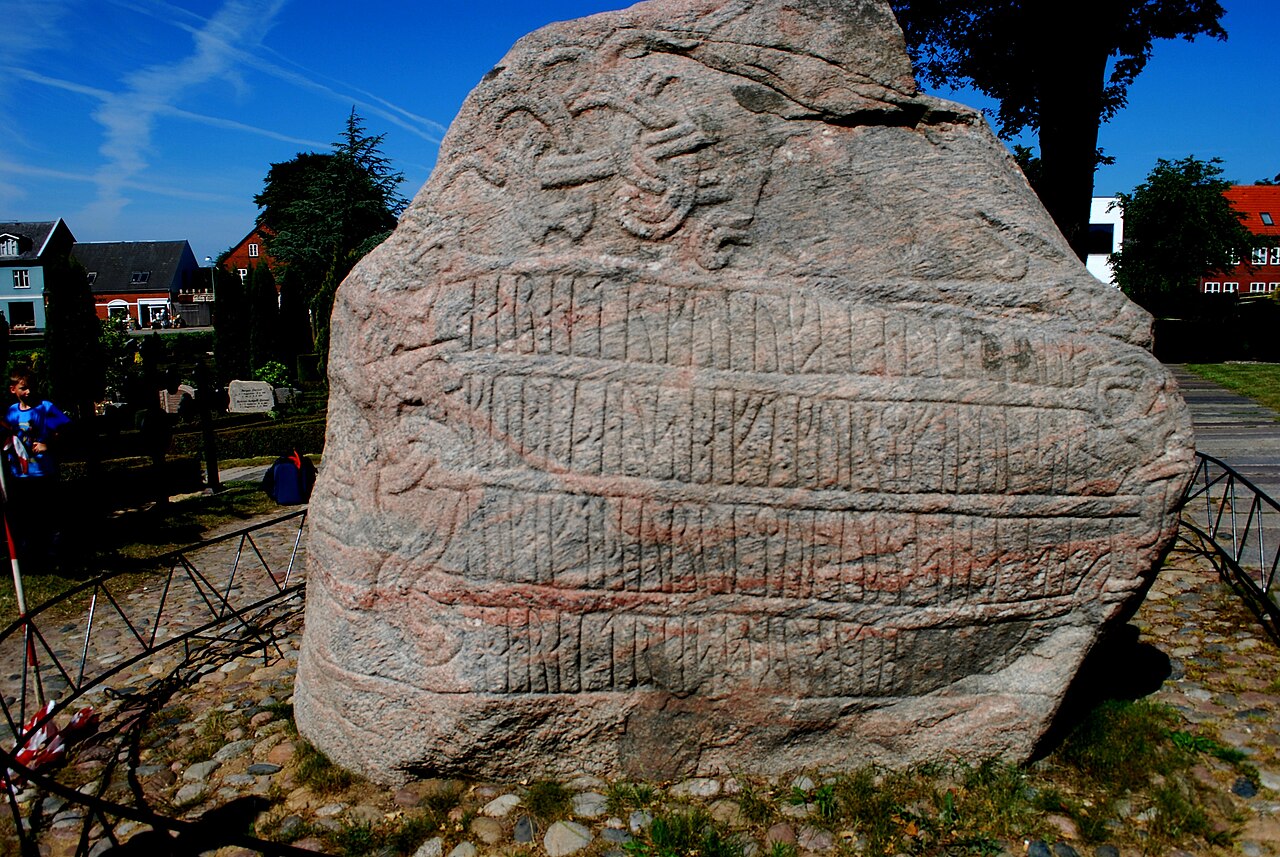
Jelling stones (
Danish:Â
Jellingstenene) are massive carvedÂ
runestones from the 10th century, found at the town ofÂ
Jelling inÂ
Denmark. The older of the two Jelling stones was raised by KingÂ
Gorm the Old in memory of his wifeÂ
Thyra. The larger of the two stones was raised by King Gorms son,Â
Harald Bluetooth, in memory of his parents, celebrating his conquest of Denmark andÂ
Norway, and his conversion of the Danes to Christianity. TheÂ
runic inions on these stones are considered the best known in Denmark. In 1994, the stones, in addition to the burial mounds and small church nearby, were inscribed on theÂ
UNESCOÂ
World Heritage List as an unparalleled example of both pagan and Christian Nordic culture

The stones are strongly identified with the creation of Denmark as a nation state. Both inions mention the name Danmark (in the form of accusative tanmaurk () on the large stone, and genitive tanmarkar (pronounced ) on the small stone).The larger stone explicitly mentions the conversion of Denmark from Norse paganism and the process of Christianization, alongside a depiction of the crucified Christ; it is therefore popularly dubbed Denmarks baptismal certificate (Danmarks dåbsattest), an expression coined by art historian Rudolf Broby-Johansen in the 1930s. In 1997 a photo of this stone inspired the name Bluetooth for the now-ubiquitous wireless standard
Runestone of Harald Bluetooth
The inion on the larger of the two Jelling stones (Jelling II, Rundata DR 42) translates to:
King Haraldr ordered this monument made in memory of Gormr, his father, and in memory of Thyrvé, his mother; that Haraldr who won for himself all of Denmark and Norway and made the Danes Christian.




Support
spageMajkaFritezaGaladraeltavi29
Comments (0)
 Newspaper from Colombia
 Facebook
 Instagram
 Discord
 Reddit